
Commercial Property Rental Yield in India 2026:
Office, Retail, Warehouse Rates
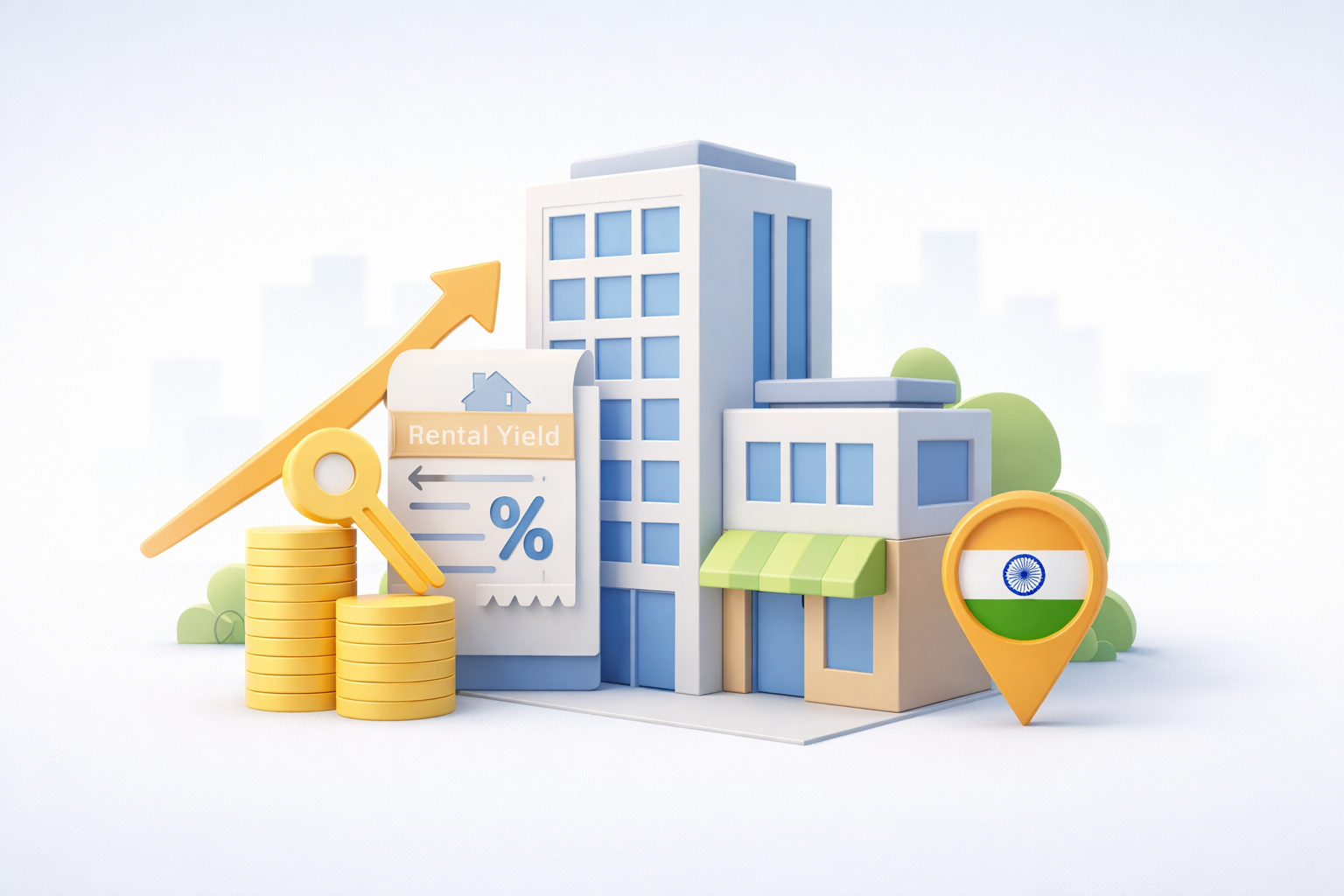
India Commercial Property Rental Yield Comparison (2026): Office, Warehouse & Industrial Property ROI Breakdown
Commercial property rental yield in India varies based on asset type, tenant demand, city category, and infrastructure growth. Warehouse rental yield in India and industrial property rental yield India are currently among the fastest-growing commercial real estate segments due to logistics expansion, e-commerce growth, and manufacturing demand.
What Is the Average Commercial Property Rental Yield in India?
Commercial property rental yield in India generally ranges between 5% and 10% annually depending on the asset class and location. Office spaces usually generate rental yields of around 6–8%, while warehouse rental yield India can range between 7–10%. Industrial property rental yield India is also among the strongest-performing segments because of increasing manufacturing activity and logistics demand.
| Commercial Asset Type | Tier-1 City Rental Yield | Tier-2 / Industrial Belt Yield | Best Performing Markets | Typical Tenant Type |
|---|---|---|---|---|
|
Office Space Rental Yield Grade-A office spaces generate stable rental income through long corporate lease agreements. |
6% – 8% | 7% – 9% | Mumbai Bangalore Gurgaon Hyderabad | IT / BFSI / GCCs |
|
Retail Shop Rental Yield Retail shops in high-footfall commercial zones generate steady rental demand. |
5% – 7% | 6% – 8% | Mumbai Delhi NCR Pune | F&B / Retail Brands |
|
Warehouse Rental Yield India Warehousing and logistics assets are benefiting from e-commerce and supply-chain growth. |
7% – 8.5% | 8% – 10% | Bhiwandi Chakan Talegaon Chennai Belt | E-Commerce / Logistics |
|
Industrial Property Rental Yield India Industrial properties in manufacturing zones often generate strong long-term rental income. |
7.5% – 9% | 8.5% – 10.5% | MIDC Zones Gujarat Pune Industrial Belt | Manufacturing Companies |
|
Co-Working Space Rental Yield Co-working assets generate high operational cash flow but involve higher management complexity. |
7% – 10% | Limited Institutional Demand | Bangalore Mumbai Hyderabad | Startups / SMEs |
Commercial Rental Yields by City — 2026
Commercial rental yield in India varies significantly across cities depending on office demand, logistics growth, infrastructure expansion, business activity, and property pricing. Mumbai, Bangalore, Hyderabad, Pune, Delhi NCR, Chennai, and Ahmedabad continue to remain among the strongest-performing commercial real estate markets 2026 in India.
| City | Office Yield | Retail Yield | Warehouse Yield | Market Outlook (2026) |
|---|---|---|---|---|
| Mumbai | 6% – 7.5% | 5% – 7% | 7% – 8% | Strong long-term commercial demand with stable office absorption and premium business districts. |
| Bangalore | 7% – 8.5% | 6% – 7.5% | 7.5% – 9% | India’s strongest office leasing market driven by IT, startups, and GCC expansion. |
| Hyderabad | 7% – 8.5% | 6% – 7.5% | 7.5% – 9% | Fast-growing commercial real estate market with improving infrastructure. |
| Pune | 7% – 8% | 6% – 7% | 8% – 9% | Balanced office and industrial growth supported by manufacturing and IT demand. |
| Delhi NCR | 6.5% – 8% | 6% – 8% | 7% – 8.5% | Strong retail and office demand in Gurgaon and Noida business corridors. |
| Chennai | 6.5% – 7.5% | 5.5% – 7% | 8% – 9.5% | Growing industrial and warehousing demand supported by port connectivity. |
| Ahmedabad | 7% – 8% | 6% – 7% | 8% – 10% | Industrial and logistics-led growth with rising investor interest. |
Commercial Property Rental Yield in India — What Investors Need to Understand in 2026
If you’ve been exploring commercial real estate India in 2026, you’ve probably heard this statement repeatedly: commercial property gives better rental returns than residential property. In many situations, that’s true. But once investors begin evaluating actual office spaces, retail shops, warehouse assets, industrial units, and pre-leased commercial properties, the reality becomes far more nuanced. Two commercial properties in the same city can produce completely different investment outcomes. One office unit may remain occupied for years with stable cash flow and long lease visibility, while another may struggle with vacancy despite promising attractive rental returns on paper. This is exactly why understanding commercial property rental yield has become one of the most searched commercial real estate queries in India today. Investors are no longer looking only for appreciation. Most buyers now prioritise stable monthly income, predictable leasing returns, tenant quality, vacancy resilience, inflation protection, and long-term business demand before making a commercial property investment decision.
Commercial property rental yield in India in 2026 typically ranges between 6% and 9% annually, depending on the city, property type, tenant quality, lease structure, and business demand surrounding the asset.
For example, if a commercial office space or retail shop is purchased for ₹1 crore and generates ₹8 lakh annual rent, the rental yield becomes 8%. Investors use this formula to compare office spaces, retail units, industrial properties, warehouses, and pre-leased commercial investments across different Indian markets.
What Is Considered a Good Commercial Rental Yield in India?
In India, commercial rental yields between 6% and 9% are generally considered strong in 2026. However, experienced investors rarely evaluate a deal using yield percentage alone. A property showing 9% yield in a weak market may actually be riskier than a property generating 6.5% yield in a strong commercial corridor with stable tenant demand and low vacancy levels. This is why investors evaluating commercial rental yield in Mumbai, Bangalore, Hyderabad, Pune, Chennai, Ahmedabad, and Delhi NCR focus heavily on business ecosystem strength, tenant profile, occupancy stability, and long-term leasing demand rather than simply chasing the highest return percentage available online.
Why Commercial Property Rental Yield Is Higher Than Residential Yield
Commercial properties usually generate higher rental income than residential homes because businesses are willing to pay heavily for visibility, accessibility, and operational convenience. A retail shop in a high-footfall market directly impacts business revenue. An office located near a corporate district improves employee accessibility and business positioning. Because of this, commercial tenants often pay substantially higher rent compared to residential tenants.
- Commercial leases usually range between 3 and 9 years
- Most agreements include 2–5 year lock-in periods
- Rent escalation clauses often increase rent every 3–5 years
- Commercial tenants usually provide larger security deposits
- Corporate leasing structures create more predictable cash flow
These factors collectively create stronger income potential compared to residential real estate, where tenant turnover is usually much higher and rental escalation is relatively limited.
Commercial Property vs Residential Property Rental Yield
| Investment Factor | Residential Property | Commercial Property |
|---|---|---|
| Typical Rental Yield | 2% – 3% | 6% – 9% |
| Lease Duration | 11–24 months | 3–9 years |
| Vacancy Risk | Lower | Higher |
| Tenant Type | Individuals/Families | Businesses/Corporates |
| Rental Escalation | Limited | Structured escalation clauses |
| Investment Nature | Emotion-driven | Business-driven |
This difference explains why many experienced investors eventually diversify toward commercial real estate. However, higher rental returns also come with higher operational responsibility, vacancy sensitivity, and economic-cycle exposure.
Which Commercial Property Gives the Highest Rental Yield?
In 2026, warehouse investments and logistics parks are among the strongest-performing commercial asset categories in India because of rapid e-commerce growth, manufacturing expansion, industrial corridor development, and logistics demand. Warehouse rental yield India currently ranges between approximately 7% and 10% depending on tenant quality and location. Retail shops in dense high-footfall commercial markets also continue generating strong leasing returns because visibility directly impacts business sales. Office spaces in established business districts typically produce slightly lower but more stable income because of long-term corporate leasing demand. Industrial property rental yield India has also improved steadily due to manufacturing growth and infrastructure expansion across industrial belts.
Commercial Rental Yield in Mumbai, Bangalore & Other Indian Cities
Commercial rental yield in Mumbai generally appears slightly lower because acquisition costs are substantially higher despite strong tenant demand and premium office absorption. Bangalore continues attracting strong office demand due to technology expansion, GCC growth, and startup ecosystems. Hyderabad remains attractive because of lower entry pricing combined with increasing corporate absorption. Pune benefits from both IT and industrial demand, while Ahmedabad and Chennai continue seeing growth in warehousing and manufacturing-linked commercial activity. Investors should understand that rental yield depends not only on rent generated but also on the price at which the property is acquired. Two investors purchasing identical commercial units at different acquisition costs can experience completely different returns.
Risks That Can Reduce Commercial Property Returns
While commercial leasing returns may look attractive on paper, several factors can reduce actual profitability significantly. Vacancy remains one of the biggest risks in commercial real estate. If a retail shop or office space remains vacant for several months, effective annual yield drops sharply while the owner continues paying EMIs, maintenance charges, and property taxes.
- Long vacancy periods reduce real rental yield
- Commercial buildings often have higher maintenance costs
- Economic slowdowns directly affect tenant demand
- Weak business ecosystems increase leasing risk
- Overpaying for a property reduces long-term returns
This is why experienced investors prioritise sustainable business demand and tenant stability over aggressive marketing claims or unrealistic yield projections.
How to Evaluate Commercial Property Rental Yield Before Investing
One of the smartest approaches while evaluating commercial property investment in India is studying actual rental transactions instead of relying only on brochures or projected returns. Vacancy levels inside a building often reveal more about investment quality than marketing presentations. Sometimes a slightly lower yield in a fully occupied commercial building is significantly safer than a higher yield in a struggling project with weak tenant absorption.
- Verify actual rent with local brokers and recent transactions
- Study vacancy levels inside the building
- Review lock-in periods and escalation clauses carefully
- Evaluate tenant business stability and financial strength
- Check maintenance liabilities and operating expenses
- Understand future infrastructure and business demand nearby
Commercial Property Rental Yield Trends in India 2026
Several trends are currently reshaping commercial real estate India in 2026. Global Capability Centres (GCCs) continue expanding office demand in Bangalore, Hyderabad, Pune, and Chennai. Warehousing demand remains strong because of manufacturing growth, supply-chain restructuring, and e-commerce expansion. Industrial property demand has improved across logistics corridors and industrial zones due to infrastructure upgrades and production-linked investments. Retail leasing has also stabilised in premium high-footfall markets after earlier disruptions caused by hybrid consumer behaviour. Investors are increasingly prioritising stable income-generating assets over speculative appreciation-driven purchases, which is one of the main reasons commercial rental yield has become a central investment metric across India.
Final Thoughts on Commercial Property Rental Yield
Commercial property rental yield can absolutely become a powerful source of long-term income and portfolio diversification when evaluated correctly. But yield percentages alone never guarantee a successful investment. The strongest commercial real estate investments are usually the ones where business demand remains healthy, tenant quality remains stable, and the location continues attracting commercial activity year after year. In 2026, the most successful commercial property investors are not necessarily the ones chasing the highest possible rental return. They are the ones prioritising sustainable cash flow, realistic acquisition pricing, strong occupancy, tenant reliability, and long-term business sustainability. That balance is what ultimately separates a stable income-generating commercial investment from a stressful one.
What is considered a good commercial property rental yield in India?
A rental yield between 7% and 9% is generally considered strong for commercial property in India. However, a slightly lower yield in a prime location with reliable tenants may still be a better investment.
How do you calculate commercial property rental yield?
Rental yield = (Annual Rental Income ÷ Property Purchase Price) × 100
Example:
Property price: ₹1 crore
Annual rent: ₹8 lakh
Rental yield = 8%
Which commercial property gives the highest rental yield?
Retail shops in high-footfall markets often produce the highest rental yields.
Warehouses linked to logistics and e-commerce demand are also generating strong returns in many cities.
Does rental yield increase over time?
Yes, rental yield can improve when rent increases over time.
Many commercial lease agreements include rent escalation clauses every few years, which gradually increase rental income.
Should investors choose property only based on rental yield?
No.
Rental yield is only one factor in commercial property investment.
Investors should also consider:
- Location strength
- Tenant reliability
- Vacancy risk
- Long-term demand
A property with slightly lower yield but strong tenant demand may produce more stable long-term returns.




Get In Touch
Write to us at:
help@justimaginerealty.in
© 2026 Just Imagine Realty. All Rights Reserved.