
How To Invest In Real Estate: 6 Proven Investment Options in India (2026)
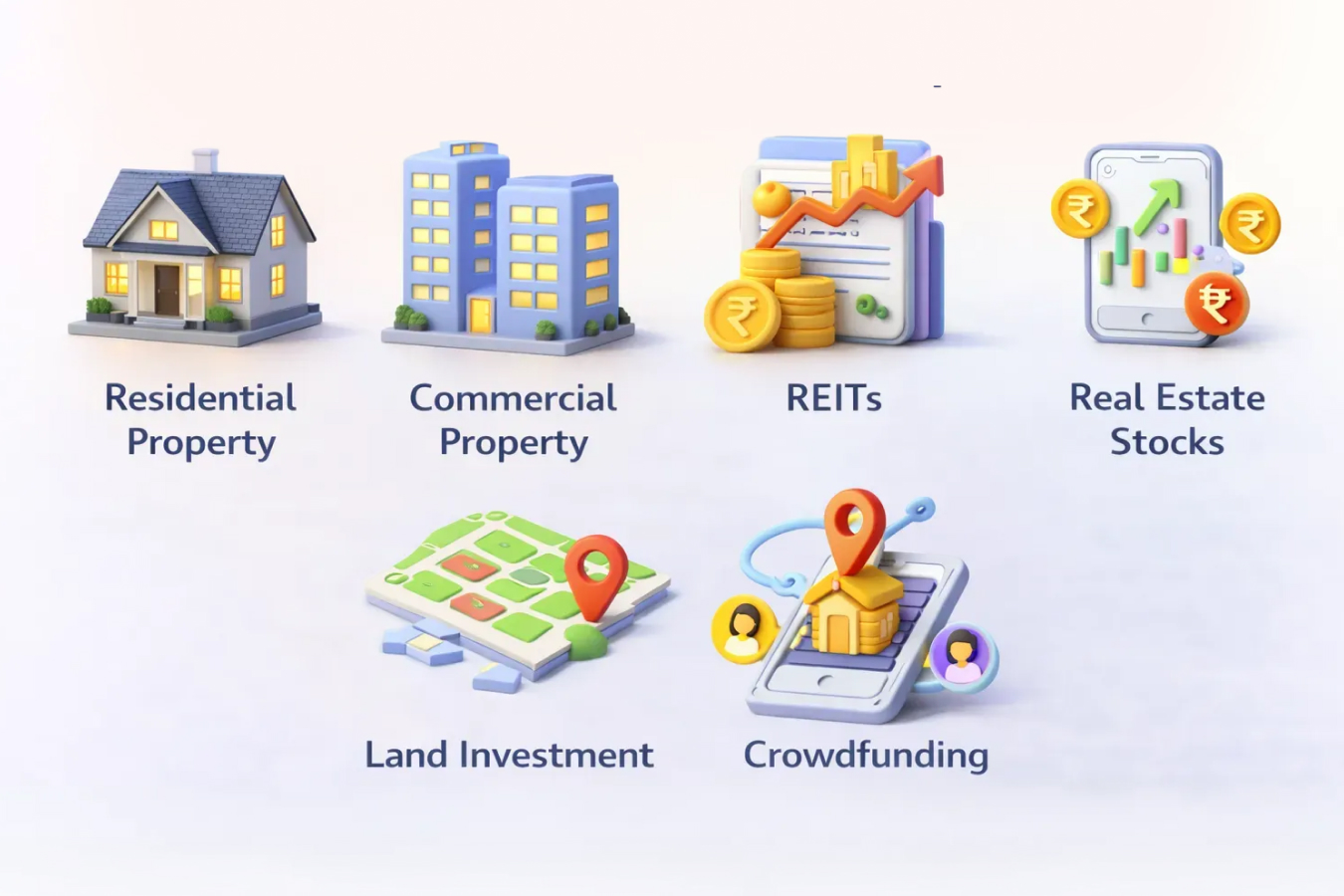
Table of Contents
Quick Summary:
What is real estate investment?
Real estate investment means buying property with the intention of long-term security, income, or appreciation — not just ownership or short-term profit.
How to invest in real estate in India through Mumbai property?
To invest in real estate in India using Mumbai property, choose a future-relevant location, keep your EMI within 35–40% of household income, verify all legal documents (especially RERA), and plan to hold the property long term.
Is buying a house in Mumbai a good property investment?
Yes, when done correctly. Mumbai remains one of India’s strongest real estate markets due to limited land, constant demand, infrastructure growth, and high resale liquidity.
How much salary do you need for property investment in Mumbai?
A safe rule is:
- Property value should be 5–6× annual household income
- EMI should stay below 35–40% of monthly income
Can you invest in real estate with no money in India?
Direct property ownership without capital is not realistic. However, entry is possible through joint ownership, redevelopment participation, REITs, or structured payment plans
Buying property in Mumbai is a strong real estate investment only when it is legally clean, financially comfortable, well-located, and held patiently. Mumbai rewards clarity — not urgency.
If this summary felt reassuring, good.
Buying property in Mumbai should slow you down — not rush you.
Now let’s walk through how real decisions are actually made, on the ground, not just on paper.
Buying a House in Mumbai Is Not Just a Transaction
Buying a house in Mumbai isn’t just paperwork and payments.
It’s the point where years of saving, random site visits, awkward broker calls, family opinions, and quiet anxiety collide into one decision.
Done right, it becomes one of the most powerful property real estate investments you’ll ever make.
Done wrong, it doesn’t explode — it quietly drains you for years.
If you’re searching for how to invest in real estate in India, starting with Mumbai — without overpaying, missing legal red flags, or stretching your finances beyond comfort — this guide is written for you.
Not as a brochure.
Not as a theory.
But real estate investment advice is grounded in how Mumbai actually works.
First, Understand This About Mumbai Real Estate
What is real estate investment in Mumbai?
Real estate investment in Mumbai means buying property based on long-term livability, demand, legal safety, and financial comfort — not hype or speculation.
Mumbai is not one property market.
It’s dozens of micro-markets, each shaped by:
- local train and metro lines
- office hubs
- redevelopment cycles
- and plain old land scarcity
That’s why:
- a 1 BHK in Andheri can cost more than a 2 BHK in Thane
- an old building can be worth more than a new one
- two homes 1 km apart can have wildly different prices
If you truly want to understand how to invest in property in Mumbai, stop comparing prices alone.
Start comparing value, connectivity, rental demand, and future relevance.
Step 1: Be Honest About Why You’re Buying
This is the question most people rush past — and later regret.
Why are you buying a house in Mumbai?
Is it for:
- living long-term?
- upgrading lifestyle?
- rental income?
- capital appreciation?
Your answer decides:
- location
- budget ceiling
- flat size
- new vs resale
Examples:
- Rental-focused buyers should stay close to metro lines and job hubs
- Lifestyle buyers should prioritise light, ventilation, and quiet lanes
- Investment-driven buyers must think resale before purchase
Clarity here saves more money than negotiation ever will.
Step 2: Budget Like a Mumbaikar (Not Like a First-Time Investor)
How to invest in real estate safely in India?
Invest in real estate safely by budgeting beyond the property price and keeping a buffer for taxes, interiors, and unexpected costs.
The flat price is never the real cost.
When planning property investment in India, especially in Mumbai, your actual outflow includes:
- Property value
- Stamp duty & registration (5–7%)
- GST (under-construction projects)
- Brokerage (1–2%)
- Parking (sometimes)
- Society deposits
- Interiors & furniture
Rule of survival:
Keep 10–12% of property value as a buffer.
Mumbai punishes tight budgets.
Step 3: Can Your Salary Comfortably Support This Property Investment?
This is where emotion meets math.
Featured Snippet Target: How much income is needed for property investment?
A safe property investment requires EMIs to stay within 35–40% of monthly income and property value within 5–6× annual income.
Simple rule:
- EMI ≤ 35–40% of household monthly income
- Property value ≤ 5–6× annual household income
Example:
- Monthly household income: ₹2.5 lakh
- Comfortable EMI: ~₹90,000
- Loan eligibility: ~₹1.2–1.3 Cr
- Ideal home budget: ₹1.5–1.6 Cr
If the EMI scares you today, it will suffocate you tomorrow.
Step 4: Choosing the Right Location (This Is Everything)
Location is not prestige.
It’s future relevance.
Locations That Work Well by Buyer Type
- First-time buyers: Thane, Mira Road, Navi Mumbai
- Working professionals: Andheri, Goregaon, Powai
- Premium lifestyle: Bandra, Juhu, Lower Parel
- Long-term investors: Chembur, Wadala, Panvel
Ask one powerful question:
Will this area still be desirable 10 years from now?
That’s how serious property real estate investment decisions are made.
Step 5: New vs Resale — Choose Based on Timeline, Not Hype
Buying New / Under-Construction
Pros
- Modern layouts
- Amenities
- Future appreciation
Cons
- Possession risk
- GST
- Dependence on developer execution
Buying Resale
Pros
- Immediate possession
- Negotiation scope
- Established locality
Cons
- Older construction
- Higher maintenance
There is no “better” option.
Only a better fit for your life stage and investment horizon.
Step 6: Legal Checks — Where Most Property Investors Lose Money
Strong income cannot save a legally weak property.
Non-Negotiable Documents
- Clear title deed
- RERA registration
- Approved building plans
- Occupancy / completion certificate
- Encumbrance certificate
- Society NOC (resale)
If documents confuse you, hire a property lawyer.
It’s the cheapest real estate investment advice you’ll ever take.
Step 7: RERA — Your Safety Net (If You Use It Properly)
Featured Snippet Target: Is RERA important for real estate investment in India?
Yes. RERA protects buyers by enforcing transparency, timelines, and accountability.
Always:
- Verify projects on MahaRERA
- Match promises with filings
- Avoid unregistered developments
No RERA number?
Walk away.
Step 8: Home Loan Strategy (Think Like an Investor, Not a Borrower)
Smart buyers don’t ask:
“How much loan can I get?”
They ask:
“How much loan should I take?”
Best practices:
- Get pre-approved
- Compare total cost, not just interest rate
- Keep EMI comfortable, not heroic
Step 9: Negotiation — Yes, It Still Works in Mumbai
Negotiation isn’t rude.
It’s expected.
Works best when:
- Inventory is ready
- Payment terms are flexible
- Timing aligns with quarter ends
End-users hesitate.
Builders don’t.
Step 10: Registration, Possession & Reality Check
Before possession:
- Inspect the flat carefully
- Prepare a snag list
- Collect all original documents
This is the finish line — and the beginning of ownership.
Before You Invest: The Salary-to-Property Reality Check
Most investors don’t fail because of bad properties — they fail because of bad leverage.
A simple rule that actually works
- Property value ≤ 5–6× annual household income
- EMI ≤ 35–40% of monthly income
Example:
- Monthly household income: ₹2 lakh
- Safe EMI: ₹70–80k
- Loan eligibility: ~₹90L–1.1Cr
- Smart property budget (with down payment): ₹1.2–1.3Cr
If the EMI makes you anxious on day one, the investment will own you — not the other way around.
1. Residential Property: Where Most Investors Should Start
Residential real estate is not exciting — and that’s exactly why it works.
Why it still delivers
- End-user driven demand
- Easier financing
- Lower vacancy risk
What actually creates wealth here isn’t luxury — it’s location + patience.
Real-world winners are usually:
- Homes near Metro lines
- Projects close to job hubs
- Areas entering redevelopment cycles
Best for: First-time investors, conservative wealth builders
2. Commercial Real Estate: When Cash Flow Matters More Than Price
Commercial property is where real estate starts behaving like a business.
Why seasoned investors prefer it
- 6–9% rental yields
- Long-term leases
- Corporate tenants
A ₹80L shop earning ₹45k/month often beats a ₹1.5Cr flat earning ₹35k.
Field truth: Vacancy risk matters more than headline yield.
3. REITs: Real Estate Without the Headaches
REITs are how young professionals are entering real estate without buying property.
You get:
- Exposure to Grade-A offices
- Quarterly income
- Stock-like liquidity
No tenants. No repairs. No society politics.
4. Land Investment: Wealth With Patience (and Paperwork)
Land doesn’t forgive mistakes — but it rewards discipline.
Why land creates outsized returns:
- Zero depreciation
- Scarcity-driven upside
- Infrastructure-triggered appreciation
Hard-earned rule: If the exit isn’t clear on day one, don’t buy.
Best for: Long-term, legally-savvy investors
5. Fractional Ownership & Crowdfunding
This is where real estate is becoming democratic.
You can now:
- Co-own premium commercial assets
- Earn proportional rent
- Exit after a defined tenure
Think of it as REITs with training wheels removed.
Best for: Young professionals, portfolio diversifiers
6. Buy–Renovate–Sell: High Skill, High Stress, High Reward
Flipping property works — but only if you treat it like a business.
It requires:
- Pricing accuracy
- Cost discipline
- Market timing
This is not passive income. This is entrepreneurship.
Best for: Full-time investors with market depth
Real Estate Advice That Actually Holds Up
After watching cycles, winners, and wipeouts:
- Cash flow keeps you calm in downturns
- Location outlives construction quality
- Legal clarity beats cheap pricing
- Leverage should feel boring — not exciting
Real estate doesn’t reward excitement. It rewards clarity.
Final Thought: How Should You Invest in 2026?
There is no best strategy.
Only the one that:
- Matches your income
- Fits your patience level
- Lets you sleep at night
India’s real estate market in 2026 is cleaner, more transparent, and opportunity-rich — if you approach it correctly.
Start simple. Stay disciplined. Let time do the heavy lifting.
How to invest in real estate in India?
To invest in real estate in India, choose a future-relevant location, keep EMIs within 35–40% of income, verify legal documents and RERA registration, and plan to hold the property long term
What is real estate investment?
Real estate investment means buying property with the intention of long-term security, income, or appreciation rather than short-term profit or emotional ownership.
Is buying property in Mumbai a good investment?
Yes, buying property in Mumbai is a good long-term investment due to limited land supply, consistent demand, infrastructure growth, and strong resale liquidity when purchased correctly.
How much salary is required for property investment in Mumbai?
A safe property investment in Mumbai requires household income that keeps EMI below 35–40% of monthly income and property value within 5–6 times annual income






Get In Touch
Write to us at:
help@justimaginerealty.in
© 2026 Just Imagine Realty. All Rights Reserved.