
Ultimate Guide to Documents Required for Home Loan Application (2026 Edition)
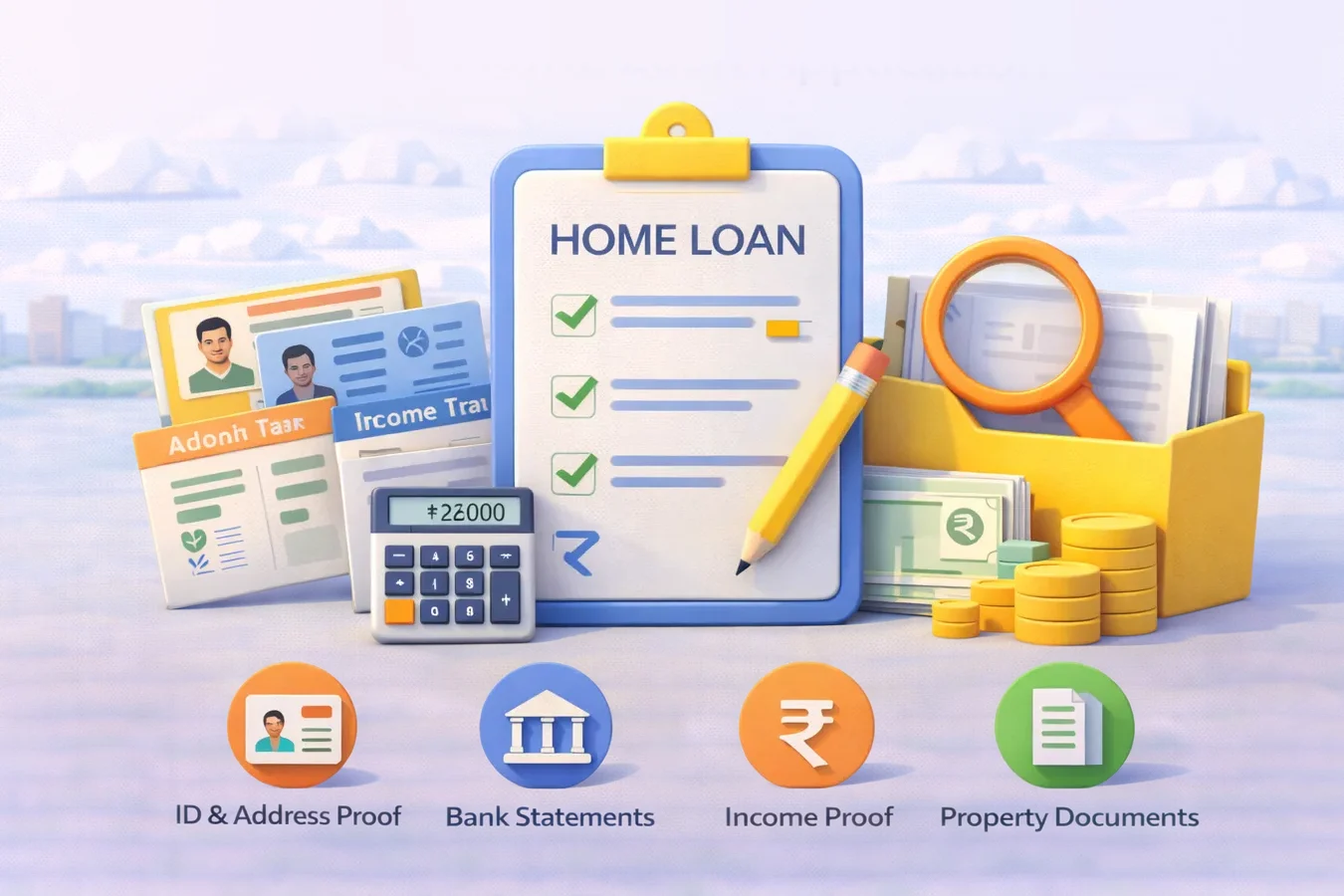
Table of Contents

Written by someone who has seen great incomes rejected and average ones approved
Applying for a home loan feels exciting… until the paperwork begins.
Most people assume loans get rejected because of low salary or poor credit score. In reality, that’s rarely the case. More than half of home loan delays and rejections happen for one simple reason:
Incomplete, inconsistent, or poorly prepared documents.
If you’ve ever wondered:
- “Why does the bank keep asking for more papers?”
- “I earn well, why is my loan stuck?”
- “What documents are actually critical vs just formalities?”
This guide is for you.
By the end of this blog, you’ll know:
- Exactly which documents are required for a home loan
- What banks really look for behind the scenes
- How to prepare your file so approval feels smooth—not stressful
Let’s start from the inside.
Why Documents Matter More Than Interest Rates
Banks don’t approve loans emotionally. They approve them based on risk clarity.
Every document you submit answers one of three questions:
- Who are you? (Identity & credibility)
- Can you repay consistently? (Income & cash flow)
- Is the property legally safe? (Collateral legitimacy)
Miss clarity on even one of these—and your file slows down.
From real experience: A clean, well-organised document file can cut approval time by 30–40%, even at the same interest rate.
Documents Required for Home Loan:
Core Categories of Home Loan Documents are:
- KYC documents
- Income & employment proof
- Bank statements
- Property documents
- Case-specific documents (NRI, under-construction, loan transfer)
Once you organise your paperwork this way, everything becomes easier for you and the banker.
KYC Documents Required for Home Loan
Every applicant and co-applicant must submit the below loan documents.
Identity Proof (Any One)
- Aadhaar Card
- PAN Card (mandatory)
- Passport
- Voter ID
- Driving License
Address Proof (Any One)
- Aadhaar Card
- Passport
- Utility bill (not older than 3 months)
- Registered rent agreement
- Bank statement with address
Insider mistake to avoid: Name or address mismatches across documents are one of the most common reasons for re-verification.
Documents Required for Salaried Employees:
For salaried borrowers, banks look for income stability, not just income size.
Income Proof
- Latest 3–6 months salary slips
- Form 16 (last 2 years)
- Appointment or confirmation letter
- Increment/appraisal letter (if available)
Employment Proof
- Company ID card
- HR confirmation (sometimes)
Bank Statements
- Last 6 months bank statements
- Salary credit should be clear and consistent
Why Form 16 still matters:
Salary slips show current income. Form 16 proves tax compliance and continuity.
Documents Required for Self-Employed:
Self-employed income fluctuates. Banks know this. What they really look for is discipline and trend stability.
Income Documents
- ITRs for last 2–3 years
- Profit & Loss statement
- Balance Sheet (audited if applicable)
Business Proof
- GST registration
- Aadhar Udhyam/Gumasta License
- Trade license
- Partnership deed / MOA–AOA (if applicable)
Bank Statements
- Last 6–12 months (business + personal)
Real-world truth: A ₹25L income with clean books beats a ₹40L income with messy filings.
Property documents required for home loan:
You can have a perfect salary and credit score, and still get rejected.
Why? Because the property itself is the loan security.
Mandatory Property Documents
- Agreement to Sell / Sale Deed
- Allotment letter (under-construction)
- Approved building plan
- Occupancy Certificate (Ready to Move Property)
- Construction Certificate (Under Construction Property)
- Encumbrance Certificate
- Latest property tax receipts
Mandatory documents required for Resale Properties
- Complete chain of previous sale deeds
- Society or builder NOC
- Possession letter
Without the above documents the loan is most probably going to get rejected.
Documents Required for Home Loan Transfer
If you’re switching banks for a lower interest rate, documentation still matters.
Home Loan Transfer Documents
- Existing loan sanction letter
- Foreclosure / outstanding statement
- Repayment track record
- Original property documents (from current bank)
- Updated KYC & income proofs
Pro tip: Maintain a 12-month clean repayment history before applying for a transfer. Your bargaining power improves dramatically.
Co-Applicant Documents: Small Detail, Big Impact
Adding a co-applicant can increase eligibility but also scrutiny and liability.
Co-Applicant Documents Required
- Identity & address proof
- Income proof (if earning)
- Bank statements
- Relationship proof (if asked)
Only earning co-applicants boost eligibility—but all co-owners must sign property papers.
Documents required in special cases such as NRI individuals:
For NRI Home Loan Applicants:
- Passport & visa
- Overseas address proof
- Foreign bank statements
- Power of Attorney (POA)
Can You Afford the Loan You’re Applying For?
(Most People Skip This Step)
Before documents, check income reality.
Safe Thumb Rule
- EMI ≤ 35–40% of monthly income
- Property value ≈ 5–6× annual household income
These tools prevent over-commitment before the bank flags it.
Common Mistakes That Kill Home Loan Files
Even smart borrowers mess this up:
- Submitting outdated bank statements
- Name mismatches across documents
- Incomplete property chains
- Hiding existing loans
Reality check: Transparency beats perfection. Always disclose everything upfront.
How to Prepare Your Home Loan Documents
Think like a banker reviewing your file:
- Separate folders: KYC / Income / Property
- Keep physical + digital copies
- Self-attest where required
- Cross-check names, dates, spellings
A neat file doesn’t just look good. It signals low-risk behaviour.
Final Thought — This Is What Actually Gets Loans Approved
A home loan isn’t approved because you want a home. It’s approved because your documents remove doubt.
Before chasing interest rates, ask yourself:
“If I were the lender, would I approve this file confidently?”
If the answer is yes, approval becomes a formality.

What documents are required for home loan in India in 2026?
If you’re applying for a home loan in India in 2026, banks usually ask for three main categories of documents:
1. Identity proof
- Aadhaar Card
- PAN Card
- Passport / Voter ID / Driving License
2. Income proof
- Salary slips (last 3–6 months)
- Bank statements (last 6 months)
- Form 16 or Income Tax Returns
3. Property documents
- Agreement copy
- Sale deed
- Builder documents
- NOC and approvals
For most middle-class buyers, the process feels complicated at first. But in reality, if your salary, bank statements, and property papers are clean, approval becomes much smoother.
Think of it this way:
Your income proves you can pay.
Your documents prove the property is safe.
Both matter equally.
What documents does a salaried person need for home loan?
For salaried people, banks mainly want to understand one thing:
“Can this person pay EMIs comfortably every month?”
That’s why salaried applicants usually need:
Personal documents:
- Aadhaar Card
- PAN Card
- Passport-size photographs
Job documents:
- Employee ID card
- Offer letter (sometimes)
- Employment proof
Salary documents:
- Last 3 salary slips
- Last 6 months bank statement
- Form 16 for last 2 years
If you work in a stable company and your salary comes regularly in the bank, banks usually prefer you because repayment is easier to assess.
Simple rule:
Stable salary = stronger loan eligibility
What property documents are needed for home loan?
Important property documents required for a home loan:
- Sale Agreement
- Title Deed
- Occupancy Certificate (OC)
- Completion Certificate (CC)
- Approved Building Plan
- RERA Registration details
- NOC from builder or society
- Property tax receipts
This matters because:
Even if your income is perfect, banks may reject the loan if the property has legal issues.
Can I apply for home loan with Aadhaar only?
No. Aadhaar alone is not enough for a home loan in India.
Aadhaar helps with:
- Identity verification
- Address verification
- e-KYC process
But banks will still ask for:
- PAN Card
- Income proof
- Bank statements
- Property documents





Get In Touch
Write to us at:
help@justimaginerealty.in
© 2026 Just Imagine Realty. All Rights Reserved.