

Commercial Property Loan Interest Rates India 2026: Bank-Wise Comparison

Table of Contents
Commercial property loan interest rates in India in 2026 are generally higher than home loan rates and usually range above residential lending rates, depending on the bank, borrower profile, and property type.
Let’s go step by step and understand how commercial property loans really work in India in 2026.
Quick Answer: Commercial property loan interest rates in India in 2026 usually range between 9.15% and 14%, depending on the lender, property type, borrower income, and business risk profile. Compared to home loans, commercial property loans typically carry higher interest rates, lower loan-to-value (LTV), and shorter repayment tenures.
What Is a Commercial Property Loan?
A commercial property loan is a loan taken to purchase property used for business purposes, such as offices, retail shops, warehouses, or industrial units.
This is different from a home loan.
Banks treat commercial property as a business asset, not a personal need. That changes:
- Interest rates
- Loan tenure
- Down payment requirements
- Risk assessment
And this is where many first-time investors get surprised.
Commercial Property Loan Interest Rates in 2026
In 2026, commercial property loan interest rates in India typically remain higher than residential home loan rates which are generally 1–3% higher than standard home loan rates, depending on borrower profile and lender policy.
Why higher?
- Commercial assets carry higher vacancy risk
- Business cycles affect rental income
- Resale may take longer
Banks price this risk into the interest rate.
Commercial Property Loan Rates in India (Bank-Wise Comparison – June 2026)
Commercial property loan interest rates in India in 2026 typically range between 9.15% and 14%, depending on lender, borrower profile, and property type.
| Bank / NBFC | Interest Rate Range | Processing Fee | Max LTV | Max Tenure | Min Loan Amount |
|---|---|---|---|---|---|
| SBI Commercial | 9.15% – 11.25% | ₹10,000 – 1% | 65% | 15 years | ₹25L |
| HDFC Commercial | 9.40% – 11.75% | Up to 1.25% | 60% | 20 years | ₹50L |
| ICICI Commercial | 9.25% – 11.50% | Up to 1% | 65% | 15 years | ₹50L |
| Axis Bank | 9.50% – 12.00% | 1% – 1.5% | 60% | 15 years | ₹50L |
| Kotak Mahindra | 9.35% – 11.75% | Up to 1% | 65% | 15 years | ₹50L |
| PNB Housing | 9.75% – 12.25% | ₹15,000 – 1% | 55% | 12 years | ₹25L |
| Bajaj Finance | 10.25% – 14.00% | Up to 2% | 60% | 20 years | ₹25L |
Typical Loan Structure in 2026
Beyond the rate, structure matters.
Here’s what you can expect:
1. Loan-to-Value (LTV)
Residential home loans may go up to 75–90% of property value.
Commercial loans typically go lower.
Commercial property loans usually finance around 50–70% of the property value, depending on the lender and borrower profile.
That means higher down payment from your side.
If you are buying a ₹1 crore office, you may need ₹30–50 lakh upfront.
2. Tenure
Commercial property loans usually have shorter tenures.
Where residential loans can go up to 20–30 years, commercial loans often range between 10–15 years.
- Higher EMI
- Faster principal repayment
- Greater monthly cash flow pressure
Always calculate EMI with conservative assumptions.
3. Interest Type
- Floating rates (linked to repo or internal benchmarks)
- Occasionally fixed or hybrid options
Floating rates can increase if RBI rates rise. That risk must be factored into cash flow planning.
Who Qualifies for a Commercial Property Loan?
Commercial property loan eligibility in India usually depends on income stability, business turnover, CIBIL score, property type, and repayment capacity. In 2026, most banks prefer borrowers with a credit score above 700, stable income records, and sufficient down payment capacity.
Many people assume eligibility is only about salary. That’s not true.
For commercial property loans, banks look at both the borrower and the property because both carry risk.
Unlike home loans, non residential property loan interest rates and eligibility rules are stricter because lenders treat offices, retail spaces, and warehouses as business-use assets.
Minimum Income or Business Turnover
There is no universal fixed number, but most lenders prefer:
- Businesses: Over ₹1Cr annual turnover (depending on lender)
Higher income does not automatically mean higher approval. Stability matters more than spikes.
A stable ₹80L annual income with clean bank statements often qualifies better than an inconsistent ₹1.5Cr income.
CIBIL Score Requirements for Commercial Property Loan
Credit score plays a major role in both eligibility and final interest rate.
- 750+ = Best rates and smoother approval
- 700–749 = Good approval probability
- 650–699 = Higher scrutiny, higher rates possible
- Below 650 = Difficult unless backed by strong income or collateral
For most banks in 2026, a CIBIL score below 700 weakens your commercial property loan eligibility significantly.
LTV Ratios by Property Type
Loan-to-Value (LTV) ratio decides how much of the property price the bank will finance. Different property types carry different risk.
| Property Type | Typical LTV Ratio | Risk Level |
|---|---|---|
| Office Space | 60% – 70% | Moderate |
| Retail Shops | 55% – 65% | Moderate to High |
| Warehouses | 50% – 65% | Higher |
| Industrial Units | 50% – 60% | Higher |
This means if you’re buying a ₹2 crore warehouse, you may need ₹70 lakh to ₹1 crore as your own contribution.
DSCR Requirements for Commercial Property Loans
DSCR (Debt Service Coverage Ratio) is one of the most important lender filters for business borrowers.
It measures whether your income comfortably covers your loan repayment.
Formula: DSCR = Net Operating Income ÷ Total Loan Obligation
Most lenders prefer:
- Minimum DSCR: 1.20x
- Healthy DSCR: 1.50x+
Example:
- Monthly business income = ₹3 lakh
- Total EMI obligation = ₹2 lakh
- DSCR = 1.5x
That’s considered strong.
If DSCR falls too low, banks may:
- Reduce loan amount
- Increase interest rate
- Ask for additional collateral
What Improves Your Commercial Property Loan Eligibility?
- Higher down payment
- Strong tenant with registered lease
- Clean repayment history
- Low existing liabilities
- Stable business cash flow
- Better credit score
In commercial lending, approval is not just about whether you can buy. It is about whether you can survive the risk that comes after buying.
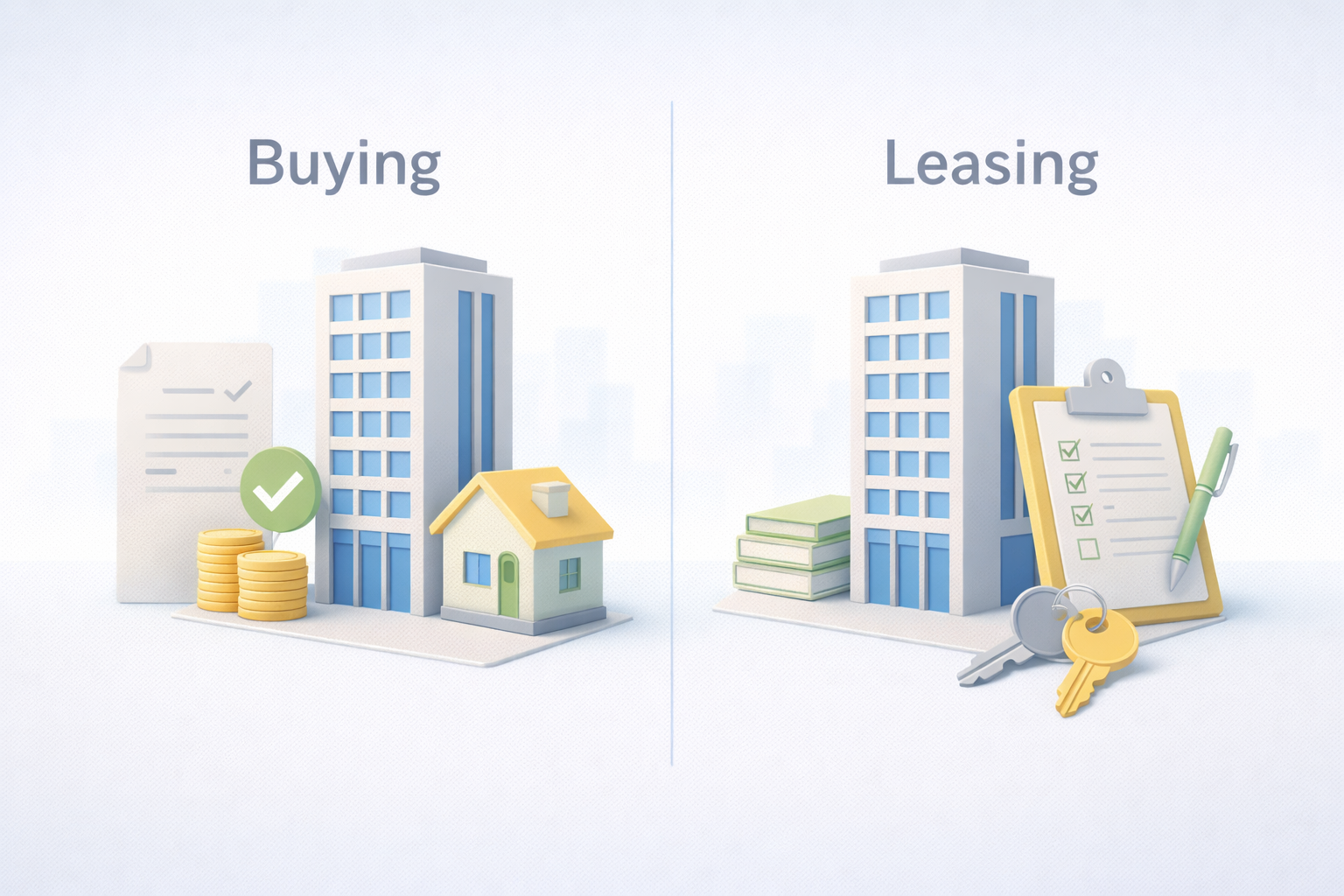
Commercial Loan vs Home Loan: Which One Makes More Sense?
The biggest difference between a commercial loan and a home loan is not just the interest rate — it is the risk profile. Home loans are built for personal housing needs. Commercial loans are built for business assets and investment income.
This distinction changes everything: your interest cost, down payment, tenure, tax treatment, and lender scrutiny.
If you are deciding whether commercial property is a good investment, this comparison matters before you commit.
| Factor | Commercial Property Loan | Home Loan |
|---|---|---|
| Interest Rate | 9.15% – 14% | 7.75% – 9.50% |
| Loan-to-Value (LTV) | 50% – 70% | 75% – 90% |
| Loan Tenure | 10 – 15 years | 20 – 30 years |
| Tax Benefits | Limited / business-linked deductions | Section 24 & 80C benefits |
| Eligibility Rules | Stricter, income + asset risk | Relatively easier |
| Vacancy Risk | Higher | Lower |
| Rental Yield Potential | 6% – 10% | 2% – 4% |
At first glance, home loans look easier — lower interest, longer tenure, and better tax benefits. And that’s true.
But commercial property often offers stronger rental yield and better cash flow potential if chosen correctly.
Simple rule: Home loans optimise affordability. Commercial loans optimise income potential.
If your goal is to build stable monthly cash flow, commercial property can be a strong investment. But only if:
- The tenant demand is strong
- The location is commercially active
- Your finances can survive vacancy
If your goal is personal stability, wealth protection, and easier financing, a home loan usually makes more sense.
This is why the better question is not: “Which loan is cheaper?”
It is:
“What kind of risk am I actually trying to take?”
That answer usually tells you whether commercial property is a good investment for you.
How Banks Evaluate a Commercial Property Loan
Banks look at more than your salary.
They evaluate:
- Your business income or professional income
- Existing liabilities
- Credit score
- Property type
- Tenant profile (if pre-leased)
If the property is already rented under a strong commercial property rental agreement, banks feel more comfortable.
Importance of Commercial Property Rental Agreement
This is critical.
A solid commercial property rental agreement improves loan approval chances.
Banks check:
- Lock-in period
- Lease tenure
- Escalation clause
- Tenant profile
- Security deposit
A registered commercial property rental agreement with a stable tenant improves loan eligibility and lender confidence.
If the property is vacant, banks may reduce loan eligibility or increase scrutiny.
Processing Fees and Other Costs
Interest rate is not the only cost.
Watch for:
- Processing fees (often 0.5–1% or more)
- Legal verification charges
- Technical valuation fees
- Foreclosure or prepayment penalties
In commercial loans, prepayment penalties are more common than in home loans.
Always read the sanction letter carefully.
EMI vs Rental Income: The Real Question
This is where most investors go wrong.
They calculate:
“Rent is ₹80,000, EMI is ₹70,000. Good deal.”
But what if:
- Tenant leaves?
- Rent drops during renewal?
- Maintenance increases?
Also Read: Rental Yield in Mumbai
Commercial property investments should be stress-tested for at least 6–12 months of vacancy risk.
If one year without rent breaks your finances, the deal is too tight.
Before deciding whether your commercial EMI makes sense, understand how rental returns actually work. Read: Rental Yield in Mumbai to understand how investors calculate real rental income, vacancy-adjusted yield, and long-term property ROI.
How Much EMI Is Safe on a Commercial Property Loan?
A safe commercial property loan EMI should ideally remain below 60–70% of the expected rental income and below 35–40% of your personal or business monthly cash flow.
For example:
- Monthly rental income: ₹80,000
- Safe EMI range: ₹45,000 – ₹55,000
- Emergency reserve: 12 months minimum
This creates enough buffer for vacancy, maintenance, and tenant turnover.
Rule: If your EMI depends on perfect occupancy, the deal is too aggressive.
Still deciding between residential and commercial borrowing? Read: Home Loan Interest Rates in 2026 to compare residential loan rates, eligibility, and tax benefits before choosing the right property strategy.
How to Invest in Commercial Property Safely Using a Loan
If you are wondering how to invest in commercial property responsibly, here’s a practical approach.
Step 1: Keep Higher Down Payment
Lower loan amount = lower risk.
Even if eligible for 65%, consider taking a 50% loan if possible.
Step 2: Choose Pre-Leased Property Carefully
Pre-leased sounds attractive.
But check:
- Actual market rent
- Lease expiry timeline
- Tenant credibility
Don’t overpay for “guaranteed rent” marketing.
Step 3: Maintain Strong Emergency Fund
For commercial property, I recommend at least:
- 12 months of EMI reserve
- Additional maintenance buffer
Commercial cycles can be unpredictable.
Step 4: Compare Lenders Properly
Don’t compare only the interest rate.
Compare:
- Processing fees
- Foreclosure rules
- Reset frequency of floating rate
- Penal charges
Sometimes a slightly higher rate with flexible terms is safer.
Who Should Take a Commercial Property Loan in 2026?
A commercial property loan makes sense if:
- Your residential needs are already settled
- You have stable business or professional income
- You can handle irregular rental cycles
- You understand lease structures
It may not suit you if:
- EMI depends entirely on rent
- You are stretching financially
- Emergency fund is weak
Commercial lending rewards financial strength, not optimism.
Also Read: Home Loan Interest Rates
Practical Takeaways
- Commercial property loan interest rates are higher than home loans
- Loan-to-value is lower; down payment must be strong
- Lease quality matters for loan approval
- Vacancy risk must be stress-tested
- Read sanction letters carefully
If you remember only one thing: In commercial property, survival during vacancy matters more than yield during occupancy.
Related Guides You Should Read Before Taking a Commercial Property Loan
Commercial property loans are only one side of the equation. Before making a final investment decision, understanding rental returns and comparing residential borrowing costs can help you make better decisions.
-
Home Loan Interest Rates in 2026
Understand how residential loan rates compare with commercial property loan rates, and when borrowing for residential real estate makes more sense. -
Rental Yield in Mumbai
Learn how rental yield works, how to calculate rental returns, and what kind of income you should realistically expect before buying any commercial property.
Conclusion
Commercial property loan interest rates in India in 2026 reflect the higher risk associated with business-use property.
That doesn’t make commercial real estate bad. It simply makes it more demanding.
If you approach it like a business—calculate carefully, build buffers, and avoid over-leverage—it can generate meaningful long-term income.
If you approach it emotionally because the rent “looks good,” it can create unnecessary stress.
Clarity before commitment is what protects both your capital and your peace of mind.


Get In Touch
Write to us at:
help@justimaginerealty.in
© 2026 Just Imagine Realty. All Rights Reserved.
