Rental Yield in Mumbai 2026: Area-Wise Guide (Kandivali, Borivali, Andheri, Thane)

Mumbai Rental Yield Area-Wise Comparison (2026): Best Areas for Rental Income, Appreciation & Long-Term Investment
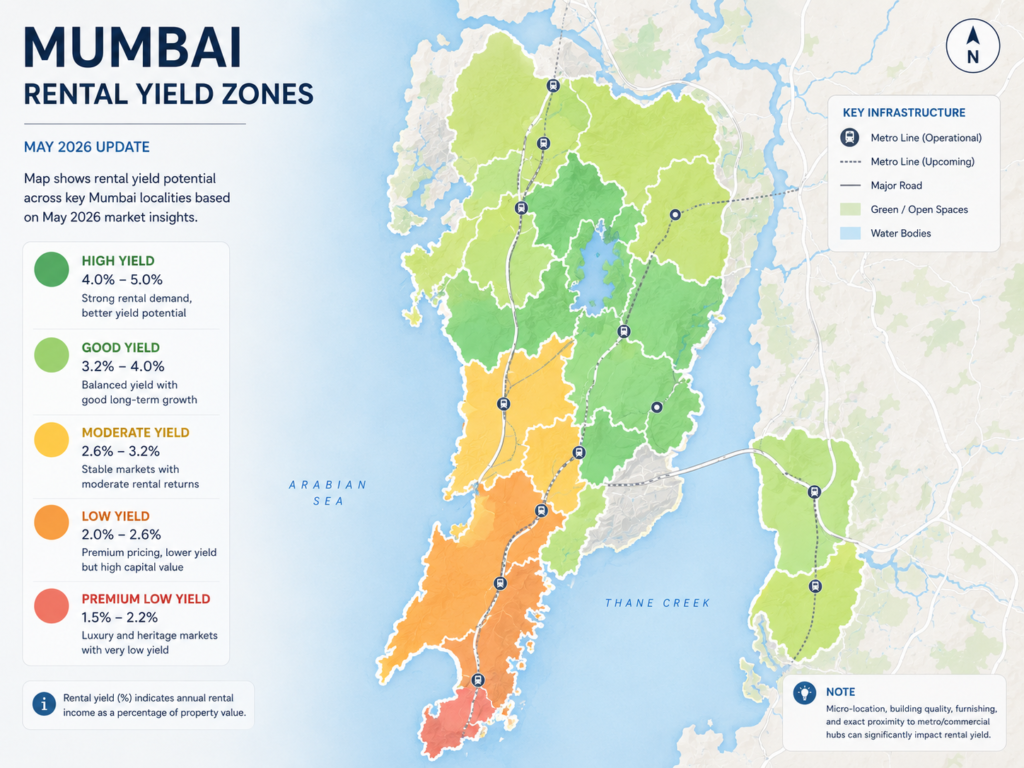
Looking for the best rental yield in Mumbai? This area-wise comparison breaks down average rental yield percentages, 2 BHK rental values, property prices, and the type of investor each location suits best. From Andheri and Powai to Thane, Navi Mumbai, Goregaon, and South Mumbai, this table helps investors understand where rental income, appreciation potential, and affordability actually make sense in 2026.
| Locality | Avg Rental Yield % | Avg Rent (2 BHK) | Avg Property Value | Best For (Investor Type) |
|---|---|---|---|---|
| Kandivali East | 3.1% – 3.7% | ₹40K – ₹58K/month | ₹2.1 Cr – ₹3.4 Cr | Family Rental Investors |
| Kandivali West | 3.0% – 3.6% | ₹42K – ₹62K/month | ₹2.3 Cr – ₹3.7 Cr | Stable Yield Seekers |
| Borivali West | 2.8% – 3.4% | ₹45K – ₹68K/month | ₹2.6 Cr – ₹4.2 Cr | Conservative Investors |
| Malad West | 3.4% – 4.0% | ₹48K – ₹75K/month | ₹2.5 Cr – ₹4.8 Cr | Growth + Rental Buyers |
| Andheri West | 3.6% – 4.2% | ₹60K – ₹95K/month | ₹3.2 Cr – ₹6.5 Cr | Premium Rental Investors |
| Andheri East | 3.8% – 4.5% | ₹55K – ₹85K/month | ₹2.8 Cr – ₹5.2 Cr | Corporate Rental Investors |
| Thane | 3.6% – 4.4% | ₹32K – ₹55K/month | ₹1.3 Cr – ₹2.8 Cr | Affordable Long-Term Investors |
| Navi Mumbai | 3.9% – 4.8% | ₹30K – ₹58K/month | ₹1 Cr – ₹2.5 Cr | Yield-Focused Investors |
| Powai | 3.7% – 4.4% | ₹70K – ₹1.15L/month | ₹3.4 Cr – ₹7.5 Cr | Premium Income Investors |
| Goregaon East | 3.5% – 4.1% | ₹50K – ₹78K/month | ₹2.6 Cr – ₹5 Cr | Mid-Premium Growth Investors |
| South Mumbai | 2.0% – 2.7% | ₹1.5L – ₹5L/month | ₹6 Cr – ₹30 Cr+ | HNI Wealth Preservation |
Calculate Rental Yield in Mumbai Instantly
Want to know if your Mumbai property is actually generating good rental returns? Use this premium rental yield calculator to instantly calculate rental yield percentage, annual rental income, monthly cash flow, and investment performance based on your property value and rent.
Annual Rental Income
₹7.8L
Net Rental Income
₹6.6L
Mumbai real estate humbles everyone first-time buyers, seasoned investors, and even brokers who think they’ve “seen it all.”
If you’re here searching for rental yield in Mumbai, chances are you’re asking a deeper question:
“Is buying property in Mumbai actually worth it anymore?”
I’ve asked that question myself standing inside half-finished towers, negotiating rents at 11 pm, watching tenants walk away over ₹2,000, and recalculating numbers that looked great on paper but felt shaky on ground.
This blog isn’t theory.
It’s not a brochure.
It’s a reality-checked guide to rental yield in Mumbai what works, what doesn’t, and why experience matters more than percentages.
Rental Yield in Mumbai: The Definition Everyone Knows, But Few Understand
Let’s start simple—but not shallow.
What Is Rental Yield in Mumbai, Really?
Rental yield in Mumbai is the annual rent you earn from a property expressed as a percentage of its purchase price.
Sounds straightforward. But here’s the catch:
Mumbai is not a yield city.
It’s a survival-of-the-smartest city.
Most investors obsess over numbers without understanding how Mumbai tenants think, how salaries actually convert to rent, and why two identical homes can deliver very different yields.
Punchline: In Mumbai, yield is less about maths and more about human behaviour.
The Real Rental Yield in Mumbai (Not the Ideal One)
Average Rental Yield in Mumbai Today
On ground, across transactions I’ve seen and tracked:
- Rental yield in Mumbai ranges between 2% and 4%
- Anything above 4% is either:
- An emerging location
- A distressed buy
- Or extremely well-executed
If someone promises you 6–7% rental yield in Mumbai without context—pause and question it.
Why Rental Yield in Mumbai Feels “Low” (But Isn’t Weak)
Mumbai property prices are high but salaries are structured to support rent, not ownership.
That’s where most people misread the market.
A ₹1.8 crore apartment renting at ₹55,000 a month looks unimpressive on paper.
But now ask this:
How many Indian cities can guarantee tenants at that rent, every year, with minimal vacancy?
This is where rental yield in Mumbai trades excitement for certainty.
Rental Yield in Mumbai Depends on Salaries More Than Prices
Here’s something most blogs won’t tell you.
Mumbai rent is salary-driven, not price-driven.
Tenants don’t ask:
“What is the owner’s EMI?”
They ask:
“Can I afford this rent from my monthly salary?”
That’s why salary calculators are quietly the most powerful tools in rental planning.
How Salary-to-Rent Logic Shapes Rental Yield in Mumbai
Most Mumbai tenants fall into this rule:
- 30–35% of monthly salary goes towards rent
So:
- ₹1.2 lakh salary → ₹35,000–40,000 rent
- ₹2 lakh salary → ₹60,000–70,000 rent
This is why homes near job hubs outperform on rental yield—even if the purchase price is higher..
Location-Wise Rental Yield in Mumbai: Where Reality Lives
Rental Yield in South Mumbai: Prestige Over Performance
Colaba. Malabar Hill. Marine Drive.
Rental yield here often sits at 1.8%–2.5%.
But that’s intentional.
Tenants here aren’t hunting for deals. They’re paying for:
- Address
- Security
- Privacy
- Legacy buildings
Rhetorical question: Are you buying yield—or buying insurance for wealth?
South Mumbai properties rarely sit vacant. Yield is modest, but capital protection is elite.
Rental Yield in Western Suburbs: Where Yield Meets Lifestyle
Andheri, Goregaon, Bandra, Santacruz—this belt tells the real Mumbai story.
- Rental yield: 2.8%–4%
- Strong demand from:
- Media professionals
- Corporate employees
- Startup founders
Andheri East near metro lines and office parks quietly delivers some of the most stable rental yield in Mumbai.
Rental Yield in Central Suburbs: The Investor’s Sweet Spot
Powai, Vikhroli, Ghatkopar—this is where yield breathes.
- Rental yield: 3.5%–4.5%
- Shorter vacancy cycles
- Younger tenant demographic
Powai stands out because rent growth keeps pace with salary growth—a rare alignment.
Ground truth: Central suburbs reward investors who think long-term, not flashy.
Rental Yield in Navi Mumbai: The Yield Champion (With Patience)
If yield is your primary goal, Navi Mumbai deserves attention.
- Rental yield: 4%–5%
- Lower entry price
- Infrastructure-led growth
But here’s the nuance:
Not every sector works. Connectivity and job access decide everything.
Property Configuration vs Rental Yield in Mumbai
Why 1 BHKs Win the Yield Game
Across Mumbai:
- 1 BHKs deliver the highest rental yield
- Demand comes from:
- Single professionals
- Young couples
- First-time movers
They match salary realities better than larger homes.
Why Luxury Homes Have Lower Rental Yield in Mumbai
Luxury homes aren’t yield products. They’re risk-mitigation assets.
- Lower churn
- Longer leases
- Better tenant quality
Ask yourself: Do you want higher yield—or fewer phone calls?
Gross vs Net Rental Yield in Mumbai: The Silent Leak
Most investors calculate rental yield once—and regret it later.
Costs That Eat Into Rental Yield in Mumbai
- Maintenance charges
- Property tax
- Brokerage during tenant change
- Vacancy gaps
- Wear and tear
Net rental yield in Mumbai is typically 1% lower than gross.
Experience rule: Always calculate yield assuming 10 months of rent, not 12.
Here’s how commercial rental yield in India works in 2026
How to Improve Rental Yield in Mumbai (Without Gambling)
This is where experience beats theory.
1. Buy Where Salaries Are Growing
Follow office corridors, not headlines.
2. Furnish Smart, Not Fancy
Wardrobes and modular kitchens increase rent.
Overdone interiors destroy ROI.
3. Price for Occupancy, Not Ego
A vacant home earns zero yield—no matter how premium it is.
Is Rental Yield in Mumbai Worth It in 2026?
Let’s be brutally honest.
Rental Yield in Mumbai Works If You:
- Think long-term
- Respect salary dynamics
- Choose micro-markets carefully
- Accept steady returns over flashy numbers
It Fails If You:
- Chase yield blindly
- Overpay emotionally
- Ignore tenant affordability
- Expect Mumbai to behave like a Tier-2 city
Final truth: Mumbai doesn’t reward shortcuts. It rewards clarity.
Final Word: The Soul of Rental Yield in Mumbai
Rental yield in Mumbai is not loud.
It doesn’t impress at dinner parties.
But it shows up—month after month, year after year.
If you treat Mumbai real estate like a business—not a dream—the city pays you back in stability, liquidity, and resilience.
Closing punchline:
In Mumbai, rental yield is not about how much you earn—it’s about how confidently you sleep at night.
What is the average rental yield in Mumbai?
The average rental yield in Mumbai typically ranges between 2% and 4%, depending on location, property type, and execution. Premium areas like South Mumbai usually offer lower rental yields due to high capital values, while central suburbs and parts of Navi Mumbai can deliver higher yields because of better affordability and strong tenant demand. In Mumbai, rental yield should always be evaluated alongside long-term capital appreciation and vacancy risk.
Is rental yield in Mumbai lower than other Indian cities?
Yes, rental yield in Mumbai is generally lower than cities like Bengaluru, Pune, or Hyderabad, where yields often cross 5%. However, Mumbai compensates with lower vacancy rates, higher rental consistency, strong liquidity, and faster resale potential. Investors often accept lower yields in Mumbai in exchange for stability and long-term wealth preservation.
Is rental yield in Mumbai better than Pune?
No, Pune generally offers higher rental yields than Mumbai.
While Mumbai rental yield usually ranges between 2.5% and 4%, Pune rental yields can often reach 4% to 6% in strong residential and IT-driven locations.
However, Mumbai compensates with:
- stronger long-term capital appreciation
- lower vacancy risk
- higher liquidity
- faster resale demand
In simple terms:
- Pune often gives better cash flow
- Mumbai often gives stronger long-term wealth preservation
The better city depends on whether your priority is income or stability.
How has Mumbai rental yield changed in 2026?
Mumbai rental yield has improved slightly in 2026 due to:
- rising rental demand
- higher migration into metro corridors
- growing office occupancy
- limited supply in key residential pockets
Locations near:
- metro stations
- business hubs
- commercial districts
have seen stronger rental growth compared to peripheral areas.
At the same time, rising property prices in premium zones continue to keep overall Mumbai rental yields moderate rather than extremely high.
In 2026, investors are focusing less on “maximum yield” and more on:
- rental consistency
- tenant depth
- long-term appreciation potential
Is investing in Mumbai real estate for rental income a good idea?
Investing in Mumbai real estate for rental income works best for long-term investors who prioritise stability, tenant depth, and capital appreciation. While rental yield alone may not be exceptionally high, Mumbai offers unmatched rental reliability and resilience. For investors who understand salary dynamics, micro-markets, and tenant behaviour, rental income becomes a strong and dependable component of overall returns.







Get In Touch
Write to us at:
help@justimaginerealty.in
© 2026 Just Imagine Realty. All Rights Reserved.