...

Commercial Property

Expected ROI from commercial property in Mumbai

ROI on Commercial Property: How Much Return Should You Actually Expect?

Menu Home Projects About Blogs Contact Us ROI on Commercial Property: How Much Return Should You Actually Expect? Table of Contents ROI on commercial property in India typically ranges between 8% and 15% annually, depending on rental yield, capital appreciation, and tenant stability.Rental yield: 6%–9%Appreciation: 4%–8%Total ROI = Combined return over time Simple takeaway:Commercial property can generate strong returns, but only when location, tenant, and purchase price are right. The Real Question Investors Are Asking If you’re considering commercial real estate, your biggest question is probably this: “What kind of ROI can I realistically expect from commercial property?” Not brochure ROI.Not “up to 18% returns” marketing claims. But real, ground-level returns. Because here’s the truth:Two investors can buy similar-looking properties and end up with completely different ROI outcomes. One earns stable income for years.The other struggles with vacancy and low returns. So before you invest, you need to understand how ROI on commercial property actually works. What Is ROI on Commercial Property? ROI on commercial property refers to the total return earned from a commercial real estate investment, including rental income and property value appreciation. It combines two components:Rental Income (Cash Flow)Capital Appreciation (Price Growth) ROI on commercial property is calculated as the total annual return (rent + appreciation) divided by the property’s purchase price. Simple Example Property price: ₹1 croreAnnual rent: ₹7 lakhAppreciation: ₹5 lakh Total return = ₹12 lakh ROI = 12% What Is a Good ROI on Commercial Property in India? This is where most investors look for clarity.A good ROI on commercial property in India typically ranges between 10% and 12%, while strong investments can generate 12% to 15% returns. Typical ROI Breakdown ComponentExpected RangeRental Yield6% – 9%Appreciation4% – 8%Total ROI8% – 15% Important:Prime locations → Lower yield, higher stabilityEmerging areas → Higher potential, higher risk How ROI on Commercial Property Actually Works Many people think ROI comes only from rent.That’s incomplete. 1. Rental yield is the most visible part of ROI. It gives you: Regular income Cash flow stability Example:₹1 Cr property → ₹7 lakh rent = 7% yield 2. Capital Appreciation (Long-Term Gain) This is where long-term wealth builds.Property value increases due to: Infrastructure growth Business demand Location maturity Example:₹1 Cr → ₹1.4 Cr over time = 40% gain 3. Lease Structure (Hidden ROI Driver) Commercial leases often include: Lock-in periods Rent escalation clauses This increases your income over time. Commercial leases with escalation clauses can increase rental income by 5%–15% every few years, improving long-term ROI. Real Example: ROI on Commercial Property 1. Rental Yield (Your Monthly Income) 2. Capital Appreciation (Long-Term Gain) 3. Lease Structure (Hidden ROI Driver) Commercial leases with escalation clauses can increase rental income by 5%–15% every few years, improving long-term ROI. Real Example: ROI on Commercial Property Here’s a realistic scenario for how much ROI a commercial property gives.InvestmentProperty price: ₹1 croreMonthly rent: ₹60,000Annual rent = ₹7.2 lakhYield = 7.2% After 5 YearsRent increases to: ₹85,000/monthProperty value grows to: ₹1.35 Cr Final OutcomeRental growth → Higher incomeProperty appreciation → Capital gain This is how real ROI builds: slow, steady, and compounding. Factors That Decide ROI on Commercial Property Location (The Biggest Factor) A strong location ensures: High demand Low vacancy Better appreciation Ask yourself:Would businesses actually want to operate here? Tenant Quality   A good tenant: Pays on time Stays longer Reduces vacancy risk A bad tenant reduces ROI drastically. Property Type Different assets behave differently: Type ROI Potential Retail Shops High (if footfall strong) Office Spaces Stable Warehouses Growing demand Purchase Price Buying at the right price is critical.Two investors buying the same property at different prices → different ROI. Vacancy Risk Vacancy periods reduce effective ROI on commercial property because income stops while expenses continue. If a commercial property remains vacant: EMI continues Maintenance continues ROI drops Commercial Property ROI vs Residential ROI Let’s compare clearly. Factor Commercial Property Residential Property Rental Yield 6% – 9% 2% – 3% ROI Potential 8% – 15% 5% – 8% Vacancy Risk Higher Lower Income Stability Medium High Commercial = higher returns + higher risk Residential = lower returns + higher stability Basic ROI Formula ROI = (Annual Rental Income + Annual Appreciation) ÷ Property Price × 100   The Mistake Most Investors Make Here’s the biggest mistake:Chasing high rental yield blindly Example: 10% yield in weak location 7% yield in strong location Most beginners choose the 10%. Experienced investors choose the 7%. Why?Because sustainability > numbers on paper Practical takeaways When evaluating ROI on commercial property, remember: Rental yield is only one part of ROI Appreciation drives long-term wealth Location matters more than percentage Tenant quality determines stability Vacancy risk can destroy returns Simple Rule For Commercial Property Investment A slightly lower ROI in a strong locationis better than a high ROI in a weak market. Final Verdict So, how much ROI should you expect from commercial property?Realistically: Healthy investment Realistically: 8% to 12% = healthy investment 12% to 15% = strong opportunity But only when: Location is strong Tenant is reliable Price is reasonable Commercial property is not a shortcut to returns. It’s a disciplined, long-term wealth strategy. FAQs: ROI on Commercial Property​ What is a good ROI on commercial property in India? A good ROI typically ranges between 10% and 12% annually, depending on location and tenant quality. How is ROI on commercial property calculated? ROI = (Annual Rent + Appreciation) ÷ Property Price × 100 Does commercial property give better ROI than residential? Yes, commercial property generally offers higher ROI, but also comes with higher risk. What reduces ROI in commercial property? Factors that reduce ROI on a commercial property are Vacancy Poor location Weak tenant Overpaying for property A good ROI typically ranges between 10% and 12% annually, depending on location and tenant quality. ROI = (Annual Rent + Appreciation) ÷ Property Price × 100 Yes, commercial property generally offers higher ROI, but also comes with higher risk. Factors that reduce ROI on a commercial property are Vacancy Poor location Weak tenant Overpaying

ROI on Commercial Property: How Much Return Should You Actually Expect? Read More »
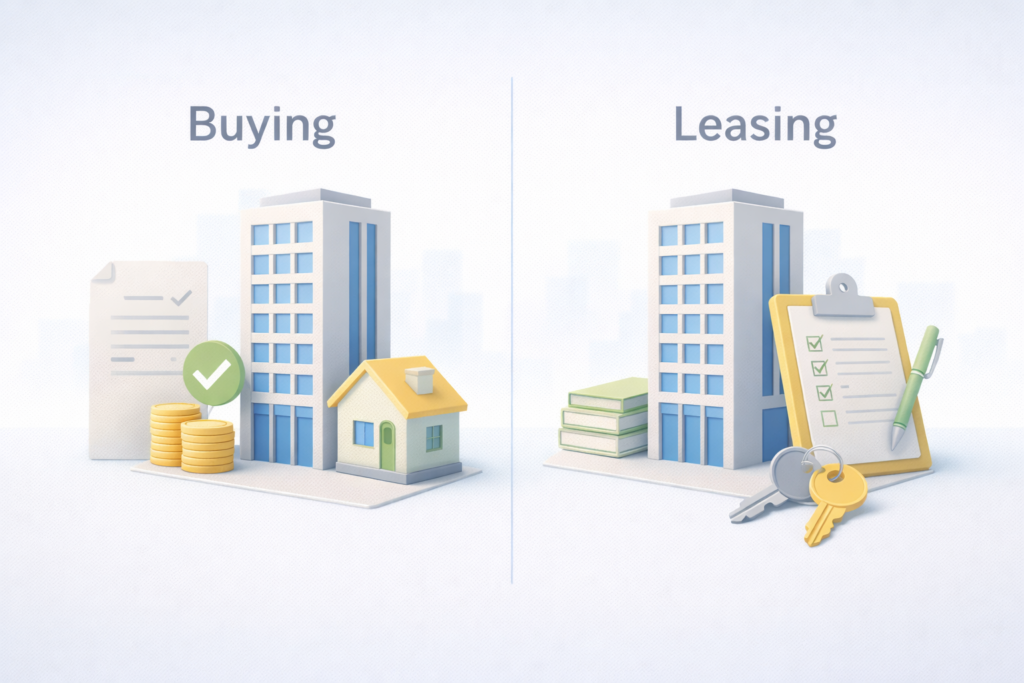
buy vs lease office space

Buy vs Lease Office Space: What’s the Better Choice?

Menu Home Projects About Blogs Contact Us Buy vs Lease Office Space: What’s the Better Choice? Table of Contents Summary: Buying office space is ideal for long-term stability and asset creation, while leasing office space is better for flexibility and lower upfront cost. Buy if your business is stable and long-term Lease if your business is growing or uncertain The right choice depends on your cash flow, growth plans, and risk appetite. The Real Question Behind “Buy vs Lease Office Space” At some point, every business owner faces this decision: “Should I buy an office or continue on rent?” On paper, it sounds simple. Buying builds an asset.Leasing gives flexibility. But in reality, this decision affects: Your working capital Your ability to scale Your financial risk Your long-term stability I’ve seen businesses struggle because they locked too much money into property too early.I’ve also seen companies regret not buying when prices doubled. So this is not just a real estate decision. It’s a business strategy decision. Understanding Buy vs Lease Office Space Before comparing, it’s important to clearly understand what each option actually means. Buying Office Space Buying office space means purchasing a commercial property that your business owns and operates from. This typically involves: Large upfront capital or loan Long-term financial commitment Ownership of a physical asset Once purchased, the office becomes: A business asset A fixed operational base A potential investment for appreciation Leasing Office Space Leasing office space means renting a commercial property under a fixed-term agreement. This involves: Monthly rent Security deposit Lease agreement conditions You don’t own the property, but you gain flexibility and lower financial pressure. Buy vs Lease Office Space — Key Differences Buying office space provides ownership and long-term value, while leasing offers flexibility and lower upfront financial burden. Here’s a clear comparison: Factor Buying Office Space Leasing Office Space Ownership You own the asset No ownership Upfront Cost Very high Low Flexibility Low High Monthly Cost EMI Rent Long-Term Benefit Asset appreciation No asset Risk Type Financial lock-in Rental dependency Buying Office Space: Benefits and Limitations Buying office space can be a strong move — but only in the right situation. Benefits of Buying Office Space Buying an office is not just an expense — it’s a long-term investment. 1. Asset Creation and Wealth Building When you buy office space, you build: Equity Asset value Long-term financial security Over time, the property itself can appreciate significantly. 2. Stability and Control Owning your office means: No rent increases No lease renewals Full control over the space This is especially valuable for long-term businesses. 3. Rental Income Opportunity If your office has extra space, you can lease it out and generate income. This helps offset costs. 4. Strong Brand Perception Owning an office signals: Stability Credibility Long-term commitment This can positively impact clients and partners. Limitations of Buying Office Space Despite the advantages, buying comes with serious trade-offs. High Capital Requirement Buying involves: Down payment Stamp duty Registration Interior costs This can significantly impact your business cash flow. Reduced Financial Flexibility Money locked in real estate cannot be used for: Hiring Marketing Expansion This is where many businesses feel restricted. Maintenance Responsibility As an owner, you are responsible for: Repairs Upkeep Building-related costs These expenses add up over time. Leasing Office Space: Benefits and Limitations Leasing is often the preferred choice for growing businesses — and for good reason. Benefits of Leasing Office Space Leasing supports flexibility and operational freedom. 1. Lower Initial Investment Leasing requires: Security deposit Monthly rent This keeps capital free for business growth. 2. Flexibility to Scale As your business grows, leasing allows you to: Upgrade office size Change location Adapt to new needs This flexibility is crucial in dynamic markets. 3. Access to Prime Locations Leasing allows businesses to operate in premium areas without huge investment. 4. Lower Operational Burden In many cases: Maintenance Infrastructure Building management Are handled by the landlord. Limitations of Leasing Office Space Leasing is flexible — but not perfect. No Ownership or Asset Creation Monthly rent does not build equity. Over time, this can feel like a lost opportunity. Rent Increases Over Time At lease renewal: Rent may increase Terms may change This creates uncertainty. Limited Customisation Tenants may face restrictions on: Structural changes Layout modifications Advantages of Buying Office Space For many established businesses, buying office space can offer several long-term benefits. 1. Long-Term Asset Creation When you buy office space, you are building a long-term asset for your company. Commercial properties can appreciate in value, providing wealth creation in addition to business use. Over time, the property may become a valuable financial resource. 2. No Rental Uncertainty Businesses that own their office space do not have to worry about rising rent or lease renewal issues. This provides stability and predictable costs. 3. Potential Rental Income If the office space is larger than required, owners can lease out unused areas to other businesses and generate rental income. 4. Brand and Business Stability Owning an office can strengthen a company’s brand identity. Clients and partners often view owned commercial space as a sign of long-term stability. Disadvantages of Buying Office Space While buying office space has advantages, it also comes with several challenges. High Upfront Investment Purchasing commercial property requires a large capital investment. Down payments, stamp duty, registration costs, and interior setup can significantly increase the overall cost. Reduced Financial Flexibility Capital tied up in real estate may reduce funds available for business expansion, hiring, or operations. Maintenance Responsibilities Property owners must handle maintenance, repairs, and building management costs, which can add to long-term expenses. Advantages of Leasing Office Space Leasing is a popular option for startups and growing businesses because it offers flexibility and lower financial commitment. 1. Lower Initial Investment Leasing requires significantly lower upfront costs compared to purchasing property. Businesses typically pay a security deposit and monthly rent instead of investing large capital. 2. Greater Flexibility Companies can relocate easily when business needs change. This flexibility is particularly

Buy vs Lease Office Space: What’s the Better Choice? Read More »

Best Cities in India for Commercial Property Investment

Best Cities in India for Commercial Property Investment

Menu Home Projects About Blogs Contact Us Best Cities in India for Commercial Property Investment Table of Contents Summary: Commercial real estate has become an increasingly attractive investment option in India. With businesses expanding, startups growing, and infrastructure improving across the country, commercial properties such as offices, retail shops, and warehouses are seeing rising demand. However, one of the most important factors that determines the success of a commercial property investment is location. Choosing the best city for commercial investment can significantly impact rental income, vacancy rates, and long-term appreciation. In this guide, we explore the best cities in India for commercial property investment, along with the factors that make these markets attractive for investors. Key Factors to Evaluate Before Choosing a City When analyzing the best city for commercial investment, investors should consider several factors. Economic Growth Cities with strong economic activity attract businesses, which increases demand for commercial real estate. Infrastructure Development Metro connectivity, highways, airports, and business parks significantly influence commercial property demand. Corporate Presence Cities with IT parks, financial districts, and industrial zones often offer better opportunities for office and retail investments. Rental Yield Potential Investors should evaluate average rental yields in different cities before making a decision. Best Cities in India for Commercial Property Investment India has several cities that offer strong opportunities for commercial real estate investors. Below are some of the best cities for commercial investment based on business growth, infrastructure, and demand. 1. Bengaluru Bengaluru is widely considered one of the best cities for commercial property investment in India. Known as the country’s technology hub, the city attracts global IT companies, startups, and multinational corporations. Key advantages include: Strong demand for office spaces Large presence of tech companies and startups High rental demand in business districts Continuous infrastructure development Areas such as Whitefield, Electronic City, and Outer Ring Road have become major commercial hubs, making Bengaluru a popular destination for investors. 2. Mumbai Mumbai remains India’s financial capital and continues to be one of the best cities for commercial investment. The city hosts major financial institutions, multinational corporations, and large retail markets. Why Mumbai attracts commercial investors: High demand for premium office spaces Strong corporate presence Established commercial districts High-value retail locations Areas such as Bandra-Kurla Complex (BKC), Lower Parel, and Nariman Point are known for premium commercial properties and strong rental demand. 3. Hyderabad Hyderabad has emerged as a rapidly growing commercial real estate market in recent years. The city’s strong IT sector, business-friendly policies, and improving infrastructure make it one of the best cities for commercial investment. Key factors driving growth include: Expanding IT and technology sector Affordable commercial property prices compared to other metros Modern business parks and infrastructure High demand for office spaces Areas like HITEC City, Gachibowli, and Financial District are popular for commercial investments. 4. Pune Pune has become a major hub for IT companies, manufacturing industries, and educational institutions. The city offers strong growth potential for commercial real estate investors. Reasons Pune is considered a best city for commercial investment: Rapid expansion of IT parks Increasing demand for office and retail spaces Growing startup ecosystem Strong connectivity with Mumbai Commercial hotspots include Hinjewadi, Baner, and Kharadi. 5. Delhi-NCR The Delhi-NCR region, including Gurgaon and Noida, is one of the largest commercial real estate markets in India. This region attracts businesses across industries such as IT, finance, consulting, and retail. Key reasons why it remains a best city for commercial investment: Large corporate presence Major IT and business parks Strong infrastructure development Growing demand for office spaces Areas like Cyber City (Gurgaon), Golf Course Road, and Noida Expressway are well-known commercial investment destinations. 6. Chennai Chennai is another important commercial real estate market in India, especially for the automobile, IT, and manufacturing industries. The city offers several advantages for investors: Strong industrial base Growing IT corridor Stable commercial property demand Competitive property prices compared to other metros Locations such as OMR (Old Mahabalipuram Road) and Guindy are key commercial zones. Emerging Cities for Commercial Investment Apart from major metropolitan cities, several emerging markets are also attracting investor interest. Cities such as: Ahmedabad Kochi Chandigarh Jaipur Indore are experiencing increased business activity and infrastructure development, making them potential candidates for the next generation of commercial investment hotspots. Investors looking for long-term growth opportunities may consider exploring these emerging markets. Tips for Choosing the Best City for Commercial Investment Selecting the best city for commercial investment requires careful research and planning. Consider the following tips before investing: Study Local Business Growth Cities with expanding industries and corporate presence usually offer better commercial property demand. Analyze Rental Yields Compare rental yields across different cities to understand income potential. Evaluate Infrastructure Projects Upcoming metro lines, highways, and business parks can significantly boost property values. Assess Vacancy Levels High vacancy rates may indicate lower demand for commercial spaces in certain areas. Consider Long-Term Growth Invest in cities that demonstrate consistent economic growth and urban development. Final Thoughts Choosing the best city for commercial investment is one of the most important decisions in commercial real estate investing. Cities with strong economic growth, modern infrastructure, and high business activity offer the best opportunities for rental income and long-term appreciation. Markets such as Bengaluru, Mumbai, Hyderabad, Pune, Delhi-NCR, and Chennai continue to lead India’s commercial real estate sector, while emerging cities are gradually gaining investor attention. By carefully analyzing market demand, infrastructure development, and business expansion trends, investors can identify the right location and build a profitable commercial property portfolio. Commercial real estate can be a powerful investment when the right city, location, and property type come together. FAQs: Best Cities in India for Commercial Property Investment Which is the best city for commercial property investment in India? The best city for commercial property investment in India depends on your investment goals. Cities like Bengaluru, Mumbai, and Delhi-NCR offer high demand and premium rental income, while Hyderabad and Pune provide a balance of affordability and growth potential. What factors should I consider before

Best Cities in India for Commercial Property Investment Read More »

Invest in Commercial Property in India

How to Invest in Commercial Property in India (Step-by-Step)

Menu Home Projects About Blogs Contact Us How to Invest in Commercial Property in India (Step-by-Step) Table of Contents Summary: Commercial real estate has become an attractive investment option for individuals looking to generate steady rental income and long-term capital appreciation. Compared to residential properties, commercial assets often offer higher rental yields, longer lease agreements, and professional tenants. However, many first-time investors are unsure how to invest in commercial property and what factors they should consider before making such a large financial commitment. In this guide, we will explain how to invest in commercial property in India step-by-step, along with the risks, investment options, and practical tips every investor should know. What is Commercial Property? Commercial property in India refers to any real estate asset used for business purposes — including office spaces, retail shops, showrooms, warehouses, industrial units, and co-working spaces. These properties generate income through business tenants rather than residential occupants. The main categories are: Property Type Typical Tenant Avg. Rental Yield Office Space (Grade-A) MNCs, IT companies 7%–9% Retail / High Street Shop Brands, F&B, Services 5%–8% Warehouse / Logistics E-commerce, FMCG 7%–10% Co-working Space Startups, Freelancers Variable Industrial / Manufacturing SMEs, Manufacturers 6%–9% Investors purchase these properties primarily to earn rental income and benefit from property value appreciation over time. Why Investors Choose Commercial Real Estate Many investors prefer commercial real estate because it offers different advantages compared to residential investments. Higher Rental Yield Commercial properties generally generate higher rental returns. While residential properties in India typically offer 2–3% annual yield, commercial properties may provide 6–9% rental yield depending on location and tenant quality. Longer Lease Agreements Commercial leases usually last 3–9 years with lock-in periods, which helps investors enjoy stable and predictable rental income. Corporate Tenants Commercial spaces are often leased to companies, brands, banks, and retail chains, which can result in more professional tenant management and timely rent payments. However, investors should remember that higher returns usually come with higher risk. Step-by-Step Guide: How to Invest in Commercial Property If you are exploring how to invest in commercial property, following a structured approach can help you avoid costly mistakes. Step 1: Define Your Investment Objective Every good commercial property decision starts with one question: What are you trying to achieve? Are you looking for: Steady rental income every month? Long-term capital appreciation in a growing corridor? Portfolio diversification away from residential or equities? A business premises you also own? Your answer will shape everything — the city, the asset type, the ticket size, and the holding period. A warehouse on the outskirts of Pune will behave very differently from a retail unit on MG Road, Bangalore. Both are commercial investments. But they serve different investor goals entirely. Keep in Mind: If income is your priority, target pre-leased commercial assets in established business districts. If appreciation is your priority, look at emerging corridors in Tier-1 and Tier-2 cities. Step 2: Research High-Demand Locations Location plays a critical role in the success of commercial real estate investments. Look for areas with: Strong business activity Good infrastructure and connectivity High footfall (for retail properties) Corporate presence (for office spaces) The factors that matter most while purchasing commercial property are: Connectivity: Metro access, highway proximity, airport distance Business ecosystem: Is the area home to IT parks, SEZs, retail corridors, or industrial clusters? Infrastructure pipeline: Upcoming metro lines, flyovers, or smart city projects Vacancy rates: High vacancy in a micro-market is a red flag, regardless of how attractive the price looks Real Example: An investor buys a 1,200 sq ft office unit in an IT corridor in Hyderabad for ₹1.2 crore. Monthly rent: ₹72,000. Annual rental income: ₹8.64 lakh. Rental yield = 7.2% — with a 5-year lease lock-in from a tech company. The same ₹1.2 crore invested in a standalone retail unit in a low-footfall area? Potentially lower yield, higher vacancy risk, and weaker appreciation. Locations with growing commercial ecosystems usually offer better long-term returns. Step 3: Choose the Right Type of Commercial Property Different types of commercial properties behave differently in the market. Office Spaces Popular in IT parks and business districts. These properties are often leased to corporate companies and startups. Retail Shops Retail units in malls or high-street locations benefit from high customer footfall. Warehouses and Industrial Units These properties are increasingly in demand due to the growth of e-commerce and logistics businesses. Choosing the right property type is an important part of understanding how to invest in commercial property successfully. Step 4: Conduct Thorough Legal and Title Due Diligence This step separates experienced investors from those who learn expensive lessons. Before buying commercial property in India, investors must verify: clear land title, no encumbrances or litigation, valid Occupancy Certificate (OC), approved building plan, RERA registration (for new projects), GST compliance on lease agreements, and stamp duty obligations. Key documents to verify while purchasing commercial property are: Title deed — confirms ownership history and legal transfer Encumbrance certificate — confirms no loans or disputes on the property Occupancy Certificate (OC) — confirms the building is legally fit for use Approved building plan — confirms the commercial use is legally sanctioned RERA registration — mandatory for commercial projects above threshold Lease agreement — review lock-in period, escalation clauses, and exit terms Engaging a qualified real estate lawyer for due diligence is not optional — it’s essential. Title disputes and encumbrances are among the most common and costly issues commercial investors face. Step 5: Understand Loan Options Commercial property loans differ from residential home loans. Typically, banks offer: Lower loan-to-value ratio (usually 50–65%) Higher interest rates Shorter loan tenure Before investing, calculate your EMI and total financing cost to ensure the investment remains financially viable. Step 6: Calculate Rental Yield and ROI Realistically Numbers tell the real story. Before committing, calculate these 2 figures: Real Example: Parameter Value Property Purchase Price ₹1.5 Crore Monthly Rent ₹90,000 Annual Rent ₹10.8 Lakh Annual Maintenance + Tax ₹60,000 Net Annual Income ₹10.2 Lakh Net Rental Yield 6.8% A net

How to Invest in Commercial Property in India (Step-by-Step) Read More »

Commercial Property Rental Yield in India

Commercial Property Rental Yield in India: What Investors Should Actually Expect

Menu Home Projects About Blogs Contact Us Commercial Property Rental Yield in India 2026: Office, Retail, Warehouse Rates 📈 Commercial Property Rental Yield India • Updated 2026 India Commercial Property Rental Yield Comparison (2026): Office, Warehouse & Industrial Property ROI Breakdown Commercial property rental yield in India varies based on asset type, tenant demand, city category, and infrastructure growth. Warehouse rental yield in India and industrial property rental yield India are currently among the fastest-growing commercial real estate segments due to logistics expansion, e-commerce growth, and manufacturing demand. What Is the Average Commercial Property Rental Yield in India? Commercial property rental yield in India generally ranges between 5% and 10% annually depending on the asset class and location. Office spaces usually generate rental yields of around 6–8%, while warehouse rental yield India can range between 7–10%. Industrial property rental yield India is also among the strongest-performing segments because of increasing manufacturing activity and logistics demand. Commercial Asset Type Tier-1 City Rental Yield Tier-2 / Industrial Belt Yield Best Performing Markets Typical Tenant Type Office Space Rental Yield Grade-A office spaces generate stable rental income through long corporate lease agreements. 6% – 8% 7% – 9% Mumbai Bangalore Gurgaon Hyderabad IT / BFSI / GCCs Retail Shop Rental Yield Retail shops in high-footfall commercial zones generate steady rental demand. 5% – 7% 6% – 8% Mumbai Delhi NCR Pune F&B / Retail Brands Warehouse Rental Yield India Warehousing and logistics assets are benefiting from e-commerce and supply-chain growth. 7% – 8.5% 8% – 10% Bhiwandi Chakan Talegaon Chennai Belt E-Commerce / Logistics Industrial Property Rental Yield India Industrial properties in manufacturing zones often generate strong long-term rental income. 7.5% – 9% 8.5% – 10.5% MIDC Zones Gujarat Pune Industrial Belt Manufacturing Companies Co-Working Space Rental Yield Co-working assets generate high operational cash flow but involve higher management complexity. 7% – 10% Limited Institutional Demand Bangalore Mumbai Hyderabad Startups / SMEs Office Space Rental Yield Grade-A office spaces generate stable rental income through long corporate lease agreements. Tier-1 Yield 6% – 8% Tier-2 Yield 7% – 9% Best Markets Mumbai Bangalore Gurgaon Tenant Type IT / BFSI / GCCs Warehouse Rental Yield India Warehouse assets are benefiting from rapid logistics and e-commerce growth. Tier-1 Yield 7% – 8.5% Tier-2 Yield 8% – 10% Best Markets Bhiwandi Chakan Talegaon Tenant Type E-Commerce / Logistics Industrial Property Rental Yield India Industrial assets near manufacturing corridors generate strong long-term yields. Tier-1 Yield 7.5% – 9% Tier-2 Yield 8.5% – 10.5% Best Markets MIDC Gujarat Pune Belt Tenant Type Manufacturing Important: Commercial property rental yield depends heavily on location quality, tenant strength, lease structure, vacancy risk, and purchase price. Higher rental yield alone does not guarantee a better investment. Commercial Rental Yields by City — 2026 Commercial rental yield in India varies significantly across cities depending on office demand, logistics growth, infrastructure expansion, business activity, and property pricing. Mumbai, Bangalore, Hyderabad, Pune, Delhi NCR, Chennai, and Ahmedabad continue to remain among the strongest-performing commercial real estate markets 2026 in India. 📈 Average Commercial Yield: 6%–9% 🏢 Office Spaces = Stable ROI 📦 Warehousing = Fastest Growing Segment City Office Yield Retail Yield Warehouse Yield Market Outlook (2026) Mumbai 6% – 7.5% 5% – 7% 7% – 8% Strong long-term commercial demand with stable office absorption and premium business districts. Bangalore 7% – 8.5% 6% – 7.5% 7.5% – 9% India’s strongest office leasing market driven by IT, startups, and GCC expansion. Hyderabad 7% – 8.5% 6% – 7.5% 7.5% – 9% Fast-growing commercial real estate market with improving infrastructure. Pune 7% – 8% 6% – 7% 8% – 9% Balanced office and industrial growth supported by manufacturing and IT demand. Delhi NCR 6.5% – 8% 6% – 8% 7% – 8.5% Strong retail and office demand in Gurgaon and Noida business corridors. Chennai 6.5% – 7.5% 5.5% – 7% 8% – 9.5% Growing industrial and warehousing demand supported by port connectivity. Ahmedabad 7% – 8% 6% – 7% 8% – 10% Industrial and logistics-led growth with rising investor interest. Mumbai Office Yield 6% – 7.5% Retail Yield 5% – 7% Warehouse Yield 7% – 8% Market Outlook Strong long-term commercial demand with stable office absorption. Important: Commercial rental yield in India depends heavily on tenant quality, lease structure, business activity, infrastructure growth, and vacancy risk. Slightly lower yields in stronger business districts often provide better long-term stability and liquidity. Commercial Property Rental Yield in India — What Investors Need to Understand in 2026 If you’ve been exploring commercial real estate India in 2026, you’ve probably heard this statement repeatedly: commercial property gives better rental returns than residential property. In many situations, that’s true. But once investors begin evaluating actual office spaces, retail shops, warehouse assets, industrial units, and pre-leased commercial properties, the reality becomes far more nuanced. Two commercial properties in the same city can produce completely different investment outcomes. One office unit may remain occupied for years with stable cash flow and long lease visibility, while another may struggle with vacancy despite promising attractive rental returns on paper. This is exactly why understanding commercial property rental yield has become one of the most searched commercial real estate queries in India today. Investors are no longer looking only for appreciation. Most buyers now prioritise stable monthly income, predictable leasing returns, tenant quality, vacancy resilience, inflation protection, and long-term business demand before making a commercial property investment decision. Quick Answer Commercial property rental yield in India in 2026 typically ranges between 6% and 9% annually, depending on the city, property type, tenant quality, lease structure, and business demand surrounding the asset. How to Calculate Commercial Property Rental Yield Rental Yield (%) = (Annual Rental Income ÷ Property Purchase Price) × 100 For example, if a commercial office space or retail shop is purchased for ₹1 crore and generates ₹8 lakh annual rent, the rental yield becomes 8%. Investors use this formula to compare office spaces, retail units, industrial properties, warehouses, and pre-leased commercial investments across different

Commercial Property Rental Yield in India: What Investors Should Actually Expect Read More »

Commercial vs Residential Property

Commercial vs Residential Property Investment: Which Makes More Money?

Menu Home Projects About Blogs Contact Us Commercial vs Residential Property: Which Makes More Money? Table of Contents Summary: Commercial vs residential property investment is a common question for investors trying to choose between steady stability and higher income potential. Commercial property such as offices, shops, or warehouses usually offers higher rental yields, often between 6–9%. Residential property typically offers lower rental yields, often around 2–3%, but it usually has more consistent demand and lower vacancy risk. What you should remember:Commercial property may make more money in rent, but residential property is usually easier to manage and less risky. Almost every real estate investor eventually reaches this question: “Should I buy a shop or another flat?” On paper, commercial property looks very attractive. The rental income seems higher and lease agreements are longer. But once you talk to actual property owners, you hear another side of the story: vacancies, tenant turnover, and loan pressure. So instead of looking only at rental yield, it helps to step back and understand how commercial vs residential property investment really works in practice. Difference Between Commercial and Residential Property Let’s start with the basics.Commercial property refers to real estate used for business activities such as offices, shops, and warehouses, while residential property is used for housing purposes. Residential properties include: Apartments Independent houses Residential plots Commercial properties include: Retail shops Office spaces Warehouses Commercial units in business complexes Because these properties serve different purposes, the way they generate income is also different. Rental Income: Where Commercial Property Usually Wins The biggest attraction of commercial property is rental yield.Commercial property typically offers higher rental yields than residential property, often between 6–9% compared to 2–3% for residential property. This happens because businesses often pay higher rents for strategic locations. For example: A retail shop in a busy market may generate strong monthly income. A residential flat in the same area may generate significantly lower rent relative to its price. For investors focused on cash flow, commercial properties can look appealing. Stability of Income: Where Residential Property Has an Advantage Income stability tells a different story in each type of property. Residential demand is consistent because people always need places to live. Commercial demand depends on business conditions. Residential properties usually have lower vacancy risk because housing demand is constant, while commercial properties may remain vacant longer if businesses are not expanding. A residential flat may find a new tenant within a few weeks or months. An office or shop may remain vacant for longer if demand slows down. Entry Cost and Financing Differences Another key difference is the initial cost of investment While purchasing, commercial properties generally require: Larger down payments Higher loan interest rates Shorter loan tenures Residential loans are usually easier to obtain and often have lower interest rates. This makes residential property more accessible for first-time investors. Lease Terms and Tenant Agreements Commercial lease agreements tend to be longer. Typical commercial leases may include: Lock-in periods of 3–5 years Rent escalation clauses Security deposits Residential leases are usually shorter, often 11 months with renewal. Longer leases in commercial property can provide predictable income, but only if the tenant remains stable. Risk Factors in Both Investments Both property types carry different types of risk. Commercial property risks: Longer vacancy periods Dependence on business activity Higher financial exposure Residential property risks: Lower rental yield Frequent tenant changes Maintenance responsibilities Understanding these risks is important before making an investment decision. Appreciation Potential Property value growth also differs between the two segments. Commercial properties may appreciate significantly if located in a strong business district. Residential properties often appreciate steadily as population and housing demand grow. However, appreciation depends heavily on: Location Infrastructure development Demand in the local market So neither category guarantees higher capital growth automatically. Which Investment Is Better for Beginners? For many first-time investors, residential property is easier to manage. Reasons include: Lower entry cost Easier financing More predictable tenant demand Commercial property may suit investors who: Already own residential assets Have stronger financial buffers Are comfortable managing business tenants Practical Takeaways When comparing commercial vs residential property investment, keep these points in mind: Commercial property often offers higher rental income Residential property usually has lower vacancy risk Commercial loans and entry costs are higher Location plays a decisive role in both cases Cash flow planning is essential for commercial assets If you remember only one thing:Higher yield usually comes with higher risk. Conclusion Choosing between commercial vs residential property investment is not simply about which makes more money. Commercial properties can produce stronger rental income, but they also demand higher capital, greater financial discipline, and the ability to handle vacancies. Residential properties, on the other hand, may produce lower yields but tend to offer steadier demand and simpler management. The right choice depends on your financial position, risk tolerance, and investment goals. For many investors, a balanced portfolio—including both types over time—often proves to be the most practical approach. FAQs: Commercial vs Residential Property Investment Which is more profitable: commercial or residential property? Commercial property generally offers higher rental yields, but also carries higher vacancy risk. Residential property tends to have steadier demand because people always need housing. Is commercial property riskier than residential property? Yes, commercial property investment usually carries higher risk because vacancy periods can be longer and rental demand depends on business activity. Residential properties typically have more consistent demand. Which property type is easier for first-time investors? Residential property is often easier for beginners because financing is simpler and tenant demand is steady. Commercial property usually requires higher capital and stronger financial planning. Can commercial property give long-term appreciation? Yes, commercial properties located in strong business districts can appreciate significantly over time. However, appreciation depends heavily on location, infrastructure, and economic activity. Should investors choose only one type of property? Not necessarily. Many experienced investors diversify their portfolios by holding both residential and commercial properties. This allows them to balance steady demand with higher rental income opportunities. Commercial property

Commercial vs Residential Property Investment: Which Makes More Money? Read More »

Is Commercial Property a Good Investment

Is Commercial Property a Good Investment in 2026

Menu Home Projects About Blogs Contact Us Is Commercial Property Investment a Good idea in 2026? Table of Contents Summary: Yes — commercial property can be a good investment in 2026, especially for investors looking for strong rental income. Commercial properties such as shops, office spaces, and warehouses usually generate higher rental yields than residential properties. However, they also carry higher risks because vacancies can last longer and loans are stricter. Simple rule to remember: Commercial property can generate steady income only when the location, tenant quality, and purchase price are right. The Question Most Investors Are Really Asking If you’ve started exploring commercial real estate, you’ve probably heard this line before: “Commercial property gives better rent than residential.” That statement is not wrong. But it’s not the full story either. Over the years, I’ve seen investors earn stable rental income for a decade from a well-located retail shop. I’ve also seen office units remain vacant for months, simply because the location didn’t attract businesses. That’s the reality of commercial property. It can perform extremely well — but only when the fundamentals are right. So before deciding whether commercial property investment in 2026 makes sense, it helps to understand how this asset actually behaves. What Is Commercial Property Investment?   Commercial property investment means buying property used for business activities to generate rental income and long-term appreciation. Unlike residential homes, which are bought mainly for living, commercial real estate is purchased primarily as an income-generating asset. Typical commercial properties include: Office spaces in business districts Retail shops in high-footfall markets Warehouses used by logistics companies Commercial units in mixed-use developments Each type behaves differently in terms of rent, demand, and appreciation. For example: Retail shops depend heavily on foot traffic.Office spaces depend on corporate demand.Warehouses depend on logistics and supply chains. Understanding these differences is what separates successful commercial investors from disappointed ones. Why Commercial Property Is Getting Attention in 2026 Commercial real estate is becoming more visible again for a few practical reasons. Growing Business Activity As businesses expand, they require more physical space. Demand is rising for: Office spaces• Retail outlets• Warehouses and logistics hubs New industries such as e-commerce, co-working spaces, and logistics companies have increased demand for certain types of commercial property. This trend is particularly visible in metro cities and emerging business hubs. How Much Rental Income Does Commercial Property Give? Commercial properties in India typically generate rental yields between 6% and 9% annually. Residential properties, in comparison, usually generate 2% to 3% rental yield. This difference is what attracts many investors toward commercial real estate. But yield alone should never decide the investment. To understand why, it helps to compare both asset types directly. Commercial Property vs Residential Property: Factor Commercial Property Residential Property Rental Yield 6% – 9% 2% – 3% Vacancy Risk Higher Lower Lease Duration 3 – 9 years 11 months Loan Approval Stricter Easier Tenant Type Businesses Individuals Commercial property offers higher income potential, but it also requires stronger location and tenant quality. Residential property, on the other hand, usually offers more stability and easier demand. Neither is universally better — they simply serve different investment goals. Real Example: Rental Yield Comparison Let’s look at a simple example. Residential investment: Property price: ₹1 croreMonthly rent: ₹25,000 Annual rent = ₹3 lakhRental yield ≈ 3% Commercial investment: Property price: ₹1 croreMonthly rent: ₹65,000 Annual rent = ₹7.8 lakhRental yield ≈ 7.8% That difference explains why many investors explore commercial property. But higher returns always come with additional responsibility. Longer Lease Agreements Commercial properties usually come with longer lease structures. Typical commercial lease agreements include: Lease duration of 3 to 9 years Lock-in periods for tenants Rent escalation clauses every few years This structure can create predictable income when the tenant is stable. However, if the tenant leaves, finding a replacement may take time. And that leads us to the biggest reality of commercial property. The Risks Investors Must Understand At this point commercial property may sound like the perfect investment. Higher rent. Longer leases. Business tenants. But experienced investors know something important: Commercial property rewards discipline, not optimism. Ignoring the risks is where many first-time investors struggle. Biggest Risk: Vacancy Commercial properties can remain vacant for longer periods because businesses are more selective about location. If a property remains empty: You still have to pay: Loan EMI Maintenance charges Property tax This is why commercial investors must plan their finances carefully. Higher Entry Cost Commercial properties generally require larger upfront capital. Banks also provide lower loan-to-value ratios compared to residential property loans. This means investors often need higher down payments. For many buyers, this becomes the biggest barrier to entry. Economic Cycles Affect Demand Commercial real estate moves closely with the economy. When business activity slows: Companies delay office expansion• Retail stores shut down or relocate• Vacancy rates increase This makes commercial property slightly more sensitive to economic cycles than residential housing. What Actually Makes a Commercial Property Successful Not every commercial property is a good investment. Three factors usually decide whether it performs well. Location and Footfall Location matters even more for commercial property than residential property. A retail shop in a busy market may rent out quickly. The same shop in a quiet lane may struggle for tenants. A simple question experienced investors ask is: “Would I run a business at this location myself?” If the answer is no, it may not be a strong commercial investment. Tenant Quality A reliable tenant can make or break a commercial property investment. Strong tenants usually have: Stable businesses• Long-term plans• Professional lease agreements If a tenant fails or shuts down, rental income stops. That’s why tenant credibility matters more than fancy marketing brochures. Lease Agreement Structure The lease agreement protects both landlord and tenant. Key things to check: Lock-in period• Rent escalation clause• Security deposit• Maintenance responsibilities A well-structured lease can significantly reduce risk. How Beginners Should Approach Commercial Property Once you understand both the opportunity and the risk, the

Is Commercial Property a Good Investment in 2026 Read More »

Commercial Real Estate Investing

Ultimate Guide to Commercial Real Estate Investing

Menu Home Projects About Blogs Contact Us Ultimate Guide to Commercial Real Estate Investing Table of Contents Summary: Commercial real estate investing means buying property used for business purposes offices, shops, warehouses, clinics, co-working spaces to earn rental income and long-term appreciation. What is commercial real estate? It is property used for business, not living.How to invest in commercial real estate? You either buy directly (office, shop, warehouse) or invest indirectly through REITs and funds. What you should remember:Commercial property can generate higher rent than residential but it also carries higher risk, longer vacancies, and bigger capital commitment. If you’re exploring commercial property, you’ve probably heard this line: “Commercial property gives double the rent.” Sometimes it does.Sometimes it also gives double the stress. I’ve seen people proudly collect 7–8% rental yields and I’ve also seen them sit with empty offices for 18 months. So let’s slow this down. Commercial real estate can work very well in India. But only when you understand what you’re signing up for. What Is Commercial Real Estate? Commercial real estate refers to property used for business purposes, such as offices, retail shops, warehouses, hotels, and industrial units. In plain terms: A 2BHK flat = residential A shop in a market = commercial An office in a business park = commercial A warehouse leased to a logistics company = commercial So when people ask, what is commercial property?It simply means property used to run a business, not to live in. That distinction matters because risk, returns, loans, and taxation all change. Commercial Real Estate Meaning in the Indian Context In India, commercial real estate meaning is closely linked to income generation. Commercial assets are usually bought for: Rental income Long lease agreements Capital appreciation Portfolio diversification Unlike residential flats, commercial properties are rarely emotional purchases. They are income decisions. And income decisions must be evaluated like a business. Why People Choose Commercial Real Estate Investing Let’s talk about the attraction. 1. Higher Rental Yield One of the biggest reasons investors consider commercial real estate is the potential for higher rental returns. Residential properties in most Indian cities typically generate 2–3% annual rental yield, which means the yearly rent earned is only a small percentage of the property’s purchase price. Commercial properties, on the other hand, can offer 6–9% rental yield, and in prime locations or well-leased properties, the returns can be even higher. Commercial properties generally offer higher rental yields compared to residential properties. This higher yield is largely due to the nature of commercial demand. Businesses rely on physical locations to operate, attract customers, and build visibility. As a result, they are often willing to pay higher rents for the right location. However, rental yield alone should not be the only factor guiding your investment decision. A high yield may sometimes indicate higher risk, such as a location with unstable demand or a property with limited tenant interest. Smart investors evaluate the sustainability of the rental income, not just the percentage return. 2. Longer Lease Tenure Another advantage of commercial property investment is the longer lease duration. While residential leases are usually signed for 11 months, commercial leases often run between 3 to 9 years, typically with a lock-in period that prevents tenants from exiting early. This structure provides several benefits: Predictable cash flow for the property owner Reduced tenant turnover compared to residential properties Greater financial stability if the tenant is a strong brand or established company Many commercial leases also include rent escalation clauses, where rent increases by around 10–15% every 3 years. This ensures that rental income keeps pace with inflation and market growth. However, longer leases can also have a downside. If a tenant vacates the property after the lease ends, finding a replacement tenant may take time. During that vacancy period, the property generates no rental income, which can impact overall returns. Because of this, the quality of the location and tenant demand becomes extremely important in commercial real estate. 3. Corporate Tenants Commercial properties often attract corporate or branded tenants, which can create a sense of security for investors. Well-known brands, retail chains, banks, and offices tend to maintain their spaces carefully and usually pay rent on time. This makes the investment feel stable and professionally managed. But investors should never rely only on the tenant’s brand name. Before purchasing a commercial property, it’s essential to carefully review the lease agreement. Key questions to ask include: Is the lease legally registered? What is the lock-in period for the tenant? Is the rent aligned with current market rates? What are the terms for renewal or exit after the lease expires? Are there maintenance or common area charges that affect net returns? A well-structured lease can significantly protect your investment. On the other hand, a poorly structured lease — even in a premium building — can reduce profitability. For example, if the rent is already above market levels, the tenant may choose not to renew after the lease ends, leaving the property vacant. This is why experienced investors focus not only on who the tenant is, but also on how strong the lease structure is. The Risks Most First-Time Investors Ignore Commercial real estate investing is not a shortcut to easy money. Here’s what people underestimate. Vacancy Risk Vacancy risk in commercial property is higher than residential because finding business tenants takes time. A house in Mumbai might stay vacant for 2–3 months.An office can remain vacant for 12–18 months. During that time: EMI continues Maintenance continues Property tax continues Can your cash flow handle that? That question matters more than yield percentage. Higher Entry Cost Commercial units are expensive. Not just purchase price but: Higher stamp duty Higher registration Higher maintenance GST implications in some cases This is not a small-ticket experiment. Loan and Interest Structure Banks treat commercial loans differently as compared to home loan interest rates. Typically: Lower loan-to-value ratio Higher interest rates Shorter tenure So when you evaluate how to invest in commercial real estate, always calculate EMI under commercial

Ultimate Guide to Commercial Real Estate Investing Read More »

GST on Commercial Property

Commercial Property Loan Interest Rates in India

Menu Home Projects About Blogs Contact Us Commercial Property Loan Interest Rates India 2026: Bank-Wise Comparison Table of Contents Commercial property loan interest rates in India in 2026 are generally higher than home loan rates and usually range above residential lending rates, depending on the bank, borrower profile, and property type. Let’s go step by step and understand how commercial property loans really work in India in 2026. Quick Answer: Commercial property loan interest rates in India in 2026 usually range between 9.15% and 14%, depending on the lender, property type, borrower income, and business risk profile. Compared to home loans, commercial property loans typically carry higher interest rates, lower loan-to-value (LTV), and shorter repayment tenures. What Is a Commercial Property Loan? A commercial property loan is a loan taken to purchase property used for business purposes, such as offices, retail shops, warehouses, or industrial units. This is different from a home loan. Banks treat commercial property as a business asset, not a personal need. That changes: Interest rates Loan tenure Down payment requirements Risk assessment And this is where many first-time investors get surprised. Commercial Property Loan Interest Rates in 2026 In 2026, commercial property loan interest rates in India typically remain higher than residential home loan rates which are generally 1–3% higher than standard home loan rates, depending on borrower profile and lender policy. Why higher? Commercial assets carry higher vacancy risk Business cycles affect rental income Resale may take longer Banks price this risk into the interest rate. Commercial Property Loan Rates in India (Bank-Wise Comparison – June 2026) Commercial property loan interest rates in India in 2026 typically range between 9.15% and 14%, depending on lender, borrower profile, and property type. Bank / NBFC Interest Rate Range Processing Fee Max LTV Max Tenure Min Loan Amount SBI Commercial 9.15% – 11.25% ₹10,000 – 1% 65% 15 years ₹25L HDFC Commercial 9.40% – 11.75% Up to 1.25% 60% 20 years ₹50L ICICI Commercial 9.25% – 11.50% Up to 1% 65% 15 years ₹50L Axis Bank 9.50% – 12.00% 1% – 1.5% 60% 15 years ₹50L Kotak Mahindra 9.35% – 11.75% Up to 1% 65% 15 years ₹50L PNB Housing 9.75% – 12.25% ₹15,000 – 1% 55% 12 years ₹25L Bajaj Finance 10.25% – 14.00% Up to 2% 60% 20 years ₹25L Disclaimer: Interest rates, fees, and loan structures may vary based on borrower profile, business income, credit score, property type, and internal lender policy. Rates are indicative as of June 2026 and should be verified directly with the bank before applying. Typical Loan Structure in 2026 Beyond the rate, structure matters. Here’s what you can expect: 1. Loan-to-Value (LTV) Residential home loans may go up to 75–90% of property value. Commercial loans typically go lower. Commercial property loans usually finance around 50–70% of the property value, depending on the lender and borrower profile. That means higher down payment from your side. If you are buying a ₹1 crore office, you may need ₹30–50 lakh upfront. 2. Tenure Commercial property loans usually have shorter tenures. Where residential loans can go up to 20–30 years, commercial loans often range between 10–15 years. Higher EMI Faster principal repayment Greater monthly cash flow pressure Always calculate EMI with conservative assumptions. 3. Interest Type Floating rates (linked to repo or internal benchmarks) Occasionally fixed or hybrid options Floating rates can increase if RBI rates rise. That risk must be factored into cash flow planning. Who Qualifies for a Commercial Property Loan? Commercial property loan eligibility in India usually depends on income stability, business turnover, CIBIL score, property type, and repayment capacity. In 2026, most banks prefer borrowers with a credit score above 700, stable income records, and sufficient down payment capacity. Many people assume eligibility is only about salary. That’s not true. For commercial property loans, banks look at both the borrower and the property because both carry risk. Unlike home loans, non residential property loan interest rates and eligibility rules are stricter because lenders treat offices, retail spaces, and warehouses as business-use assets. Minimum Income or Business Turnover There is no universal fixed number, but most lenders prefer: Businesses: Over ₹1Cr annual turnover (depending on lender) Higher income does not automatically mean higher approval. Stability matters more than spikes. A stable ₹80L annual income with clean bank statements often qualifies better than an inconsistent ₹1.5Cr income. CIBIL Score Requirements for Commercial Property Loan Credit score plays a major role in both eligibility and final interest rate. 750+ = Best rates and smoother approval 700–749 = Good approval probability 650–699 = Higher scrutiny, higher rates possible Below 650 = Difficult unless backed by strong income or collateral For most banks in 2026, a CIBIL score below 700 weakens your commercial property loan eligibility significantly. LTV Ratios by Property Type Loan-to-Value (LTV) ratio decides how much of the property price the bank will finance. Different property types carry different risk. Property Type Typical LTV Ratio Risk Level Office Space 60% – 70% Moderate Retail Shops 55% – 65% Moderate to High Warehouses 50% – 65% Higher Industrial Units 50% – 60% Higher This means if you’re buying a ₹2 crore warehouse, you may need ₹70 lakh to ₹1 crore as your own contribution. DSCR Requirements for Commercial Property Loans DSCR (Debt Service Coverage Ratio) is one of the most important lender filters for business borrowers. It measures whether your income comfortably covers your loan repayment. Formula: DSCR = Net Operating Income ÷ Total Loan Obligation Most lenders prefer: Minimum DSCR: 1.20x Healthy DSCR: 1.50x+ Example: Monthly business income = ₹3 lakh Total EMI obligation = ₹2 lakh DSCR = 1.5x That’s considered strong. If DSCR falls too low, banks may: Reduce loan amount Increase interest rate Ask for additional collateral What Improves Your Commercial Property Loan Eligibility? Higher down payment Strong tenant with registered lease Clean repayment history Low existing liabilities Stable business cash flow Better credit score In commercial lending, approval is not just about whether you can buy. It is

Commercial Property Loan Interest Rates in India Read More »

GST on Commercial Property

GST on Commercial Property Explained

Menu Home Projects About Blogs Contact Us GST on Commercial Property Explained Table of Contents Summary: GST on commercial property applies mainly in two situations: When you buy under-construction commercial property from a builder When you earn rent from commercial property and your turnover crosses the GST threshold GST on rent on commercial property is generally 18% if applicable. What you should remember:GST in commercial real estate depends on whether the property is under construction and whether rental income crosses registration limits. Not every commercial transaction attracts GST. GST is one of those topics that makes even experienced buyers uncomfortable. You hear 18% and immediately think, “Is this going to make my deal expensive?” The truth is simpler than it sounds—but only if you break it down calmly. I’ve seen buyers panic, cancel bookings, or overpay because they didn’t fully understand when GST applies and when it doesn’t. Let’s walk through it clearly. When Does GST Apply on Commercial Property Purchase? First, understand the most common confusion. GST applies on under-construction commercial property but does not apply on completed commercial property with occupancy certificate. If you buy: An office/shop that is still under construction → GST applies A ready-to-move property with Occupancy Certificate → No GST That distinction alone can save lakhs. GST Rate on Under-Construction Commercial Property For under-construction commercial units, GST is generally 18%. However, the effective rate may reduce after adjusting for land value (since land is not taxable under GST). Builders usually quote prices clearly showing the GST component. Always ask for cost sheet breakdown. What Is GST on Commercial Property Rent? Now let’s move to rental income. This is where many landlords get confused.GST on rent on commercial property is 18% if the landlord is required to register under GST. The key question is not whether rent exists.The key question is whether GST registration is mandatory. When Is GST Registration Required for Commercial Rent? If your total annual turnover from taxable services (including commercial rent) exceeds the GST threshold limit, you must register. Currently, the general threshold for services is ₹20 lakh per year (₹10 lakh in some special category states). If your total taxable turnover crosses that limit: You must charge 18% GST on commercial rent You must file GST returns You can claim input tax credit (if eligible) If it does not cross the limit, GST does not apply. This is critical. GST on Rent Paid on Commercial Property What if you are a tenant?If the landlord is GST-registered, GST at 18% applies on rent paid on commercial property. So if monthly rent is ₹1,00,000: GST at 18% = ₹18,000 Total payable = ₹1,18,000 However, if you are running a GST registered business, you may claim input tax credit on that GST. This makes a big difference for business tenants. GST on Commercial Property Rent: Practical Example Let’s simplify. Scenario 1:The landlord earns ₹15 lakh annually from rent.No other taxable income.No GST registration required.No GST charged. Scenario 2:Landlord earns ₹35 lakh annually from rent and other taxable services.GST registration required.18% GST must be charged on commercial rent. Same property. Different outcome.Why? Because GST depends on turnover, not property type alone. Reverse Charge Mechanism (Important in Some Cases) In certain situations, GST liability may fall under reverse charge, especially when renting from unregistered landlords to registered entities. Rules evolve, so professional advice is important here. GST on Sale of Commercial Property After Completion If you sell: Under-construction property → GST applies Completed property with Occupancy Certificate → No GST Instead, stamp duty and registration charges apply. So when evaluating total cost, separate GST from stamp duty. They are not the same. Impact of GST on Investment Returns This is where real investors should think. If you are: GST-registered Leasing to GST-registered tenant The GST component often becomes neutral because input tax credit can be claimed. But if you are: Not registered Renting to individuals or unregistered entities GST becomes a real cost component in rental pricing. Always factor this into yield calculations. Common Mistakes People Make Assuming GST applies on every commercial property purchase Ignoring GST threshold while renting Not factoring GST into rental agreements Forgetting compliance obligations Confusing GST with stamp duty These mistakes lead to penalties and cash flow mismatches. Practical Takeaways GST applies on under-construction commercial property, not on completed property GST on commercial property rent is 18% if landlord crosses threshold Turnover determines registration, not property type alone Tenants can claim input credit if registered Always check compliance obligations before signing agreements If you remember only one thing:GST in commercial real estate depends more on status and turnover than on the property itself. Conclusion GST on commercial property is not as complicated as it sounds—but it does require attention. If you understand when GST applies—purchase stage vs rental stage—you avoid unnecessary fear and unexpected costs. Commercial property investing already has enough moving parts. GST should not be one of the surprises. Clarity before signing agreements is what protects both your returns and your compliance record. Menu Home Projects About Blogs Contact Us Related Blogs GST on Commercial Property Explained 10/03/2026 Read More Commercial Property Loan Interest Rates in India 10/03/2026 Read More 1 2 3 4 5 Just Imagine Realty Trusted Property Investors in Mira Road & Mumbai Quick Links Projects About Us Contact Blogs Other Links T&Cs Privacy Policy Sitemap Get In Touch Write to us at: help@justimaginerealty.in © 2026 Just Imagine Realty. All Rights Reserved. Just Imagine Realty Trusted Property Investor in Mira Road & Mumbai Quick Links Projects About Us Contact Blogs Other Links T&Cs Privacy Policy Sitemap Get In Touch Write to us at: help@justimaginerealty.in © 2026 Just Imagine Realty. All Rights Reserved.

GST on Commercial Property Explained Read More »

Seraphinite AcceleratorOptimized by Seraphinite Accelerator
Turns on site high speed to be attractive for people and search engines.